Dear Readers, Strategists and Game-Changers,
Hope you are doing great!
Sometimes, the best way to explain intellectual property is not through a patent portfolio, a courtroom decision or a licensing agreement.
Sometimes, it is through an object.
In my case, a pair of earphones.
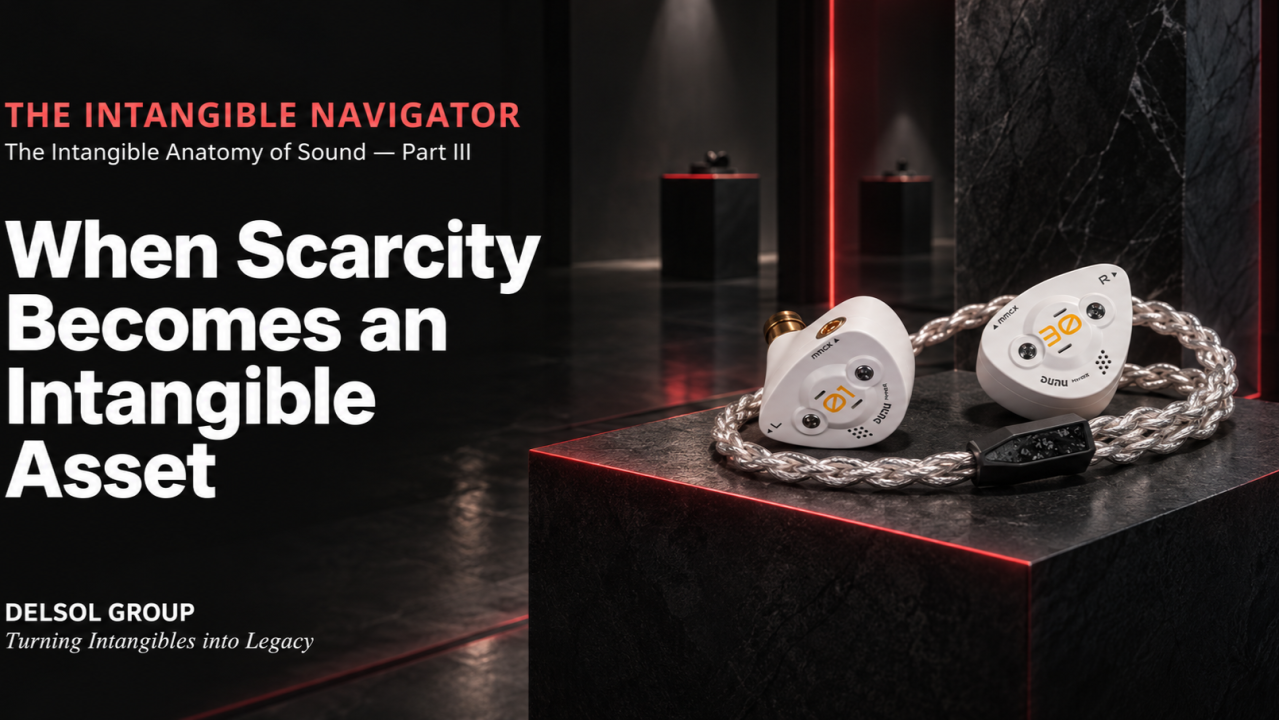
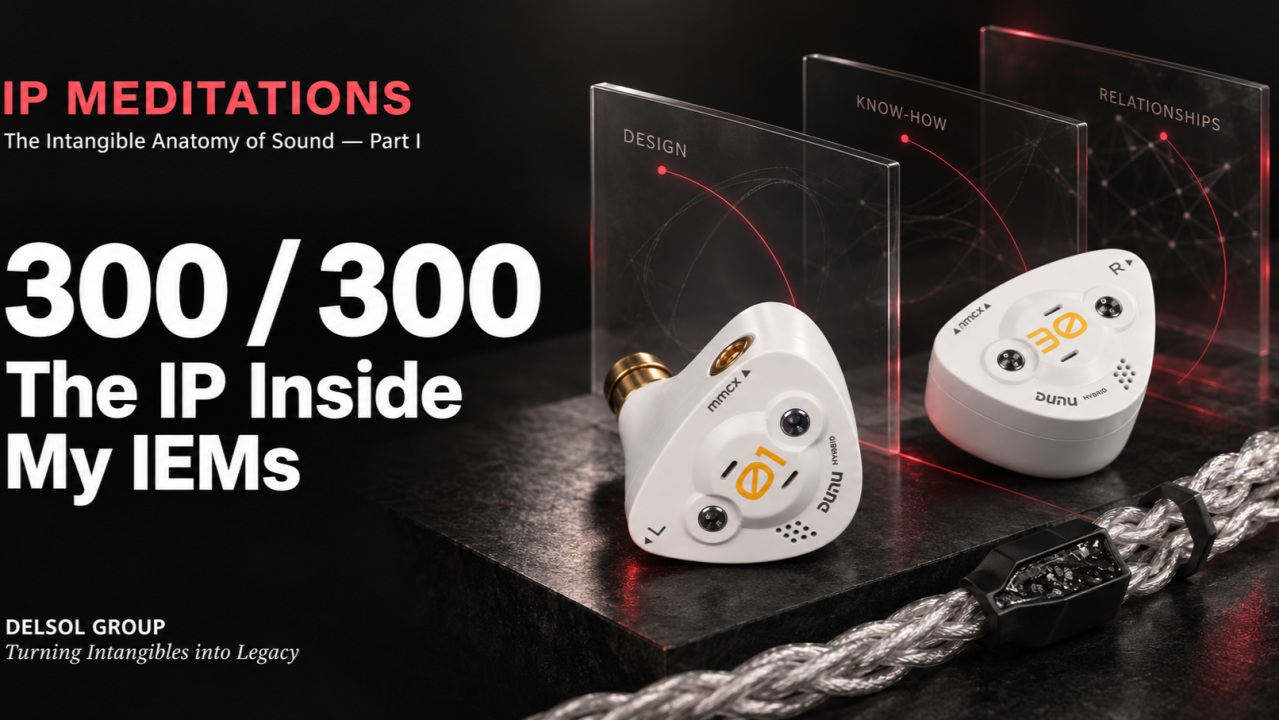
My wife offered me a pair of DUNU DK3001BD x Effect Audio Limited Edition in-ear monitors.
Only 300 units were produced worldwide. DUNU describes the model as a collaboration with Effect Audio, using a nine-driver architecture per side: one dynamic driver, four balanced-armature drivers and four planar drivers, connected through a dual-system, four-way crossover.
No coincidence: it was a gift from my wife for two specific reasons: I am what you might call an audiophile, and I am part of another group of 300... the IAM Strategy 300, which recognises individuals active in intellectual-property strategy.
Three hundred strategists. Three hundred earphones.
That was enough to make the IP strategist in me curious.
So after listening to them, I started asking another question:
What am I actually holding from an intellectual-property perspective?
The answer is much more interesting than “a pair of earphones”.
The physical product is only the visible layer
At first sight, the DK3001BD is a sophisticated piece of audio engineering.
Inside each earpiece are several different transducer technologies, each assigned different acoustic roles.
The limited edition combines this architecture with a dedicated Effect Audio cable, a distinctive finish and a specific tuning. DUNU identifies Dongguan Dadian Electronics Co., Ltd. as the company behind the brand.
But what we can see and touch represents only one layer of the product.
Behind it sits an entire architecture of intangible assets.
That architecture starts with patents.
Layer 1 — Patents
DUNU's history illustrates something important about innovation in audio.
Patent protection does not necessarily concern an entire earphone as a single object.
It can concern particular technical relationships inside it.
Earlier Chinese utility-model filings associated with Dongguan-based Dadian entities include technologies concerning earphone structures, hybrid dynamic/balanced-armature arrangements and acoustic-pressure management. One filing, for example, describes an in-ear hybrid configuration in which a dynamic unit reproduces lower frequencies while different balanced-armature units address mid and higher frequencies.
Another more recent filing concerns pressure equalisation inside an earphone cavity through venting and airflow management.
This distinction is fundamental.
A patent rarely creates strategic value simply by claiming: “We use several drivers.”
The potentially protectable invention lies more often in how the system works:
- the arrangement of components;
- their geometry;
- their acoustic pathways;
- the way pressure is managed;
- the crossover architecture;
- the interaction between materials;
- the resulting technical effect.
This is a lesson that extends far beyond audio.
Innovation is often not the component.
It is the architecture between the components.
Layer 2 — Know-how
Now consider the current DK3001BD.
Knowing that it contains one dynamic, four balanced-armature and four planar drivers does not tell you how to reproduce its sound.
You would also need to understand:
- how the drivers are positioned;
- how their outputs interact;
- how crossover points are chosen;
- how acoustic chambers are dimensioned;
- how phase relationships are managed;
- how airflow is controlled;
- how resonances are damped;
- how manufacturing tolerances are handled;
- how every unit is tested; and
- how the final product is tuned.
Some of that knowledge may be patentable.
Some may instead be much more valuable if it remains secret.
And this is where know-how and trade secrets become strategically important.
A competitor may be able to measure the frequency response of an earphone.
That does not necessarily reveal the complete recipe that produced it.
The graph may be visible. The process behind the graph may not be.
Layer 3 — The cable and interface technology
Even elements that appear secondary can contain protected technology.
The standard DK3001BD, for example, uses DUNU's Q-Lock Mini interchangeable plug system, which the company itself describes as patented.
This is an important reminder.
Innovation does not always sit inside the flagship component.
Sometimes, competitive differentiation comes from the interfaces around it:
- connectors;
- mechanical systems;
- user interaction;
- assembly;
- maintenance;
- modularity.
A sophisticated IP portfolio should therefore not look only at the “core technology”.
It should examine the entire user experience.
Layer 4 — Design
Then there is the object itself.
High-end IEMs are increasingly becoming pieces of industrial design.
Shell geometry. Materials.
Surface treatments. Colour combinations.
Nozzle architecture. Cable aesthetics.
Packaging. Tactile experience.
The DK3001BD limited edition uses a zirconium-ceramic-coated shell and a distinctive “Hyperdream” visual identity.
At this point, we are no longer talking only about engineering performance.
We are talking about recognisability.
And recognisability can become an asset.
Depending on the jurisdiction and the characteristics involved, that value may interact with registered designs, copyright, trademarks, unfair-competition rules and manufacturing know-how.
Layer 5 — The brand
Now remove every internal component.
Imagine that all you can see is the word: DUNU.
That single word may carry more accumulated market meaning than many individual technical features.
A brand compresses information. Years of reviews.
Expectations regarding sound. Manufacturing quality.
Product history. Customer experience.
Reputation. Community discussion.
Trust.
The interesting point is that technologies evolve rapidly.
Individual products disappear.
Patents eventually expire.
But a brand can persist across generations of products.
This is why trademark strategy should never be treated as an administrative appendix to patent strategy.
The two protect completely different dimensions of competitive value.
Layer 6 — Collaboration
My specific pair adds another layer.
It is not simply a DUNU product.
It is a DUNU × Effect Audio collaboration.
And collaboration creates an entire ecosystem of IP questions.
- Who owns improvements created during development?
- Who owns a modified tuning?
- Who owns testing data?
- Who owns technical information exchanged between the partners?
- Who can reuse jointly generated know-how?
- What may each company disclose?
- Can one partner use the same solution in another product?
- What rights exist after the collaboration ends?
- How may each trademark be used?
- Who controls the visual identity of the collaboration?
A small pair of earphones suddenly becomes a case study in IP governance.
The technology matters.
But the agreements controlling the technology matter too.
The real IP map
If I were mapping these IEMs for a client, I would therefore not simply prepare a list of patents.
I would map an entire system.
- Technology: Drivers, crossover, acoustic architecture, airflow management, materials and interfaces.
- Patents and utility models: Specific technical implementations capable of creating exclusivity.
- Trade secrets: Tuning processes, manufacturing tolerances, acoustic optimisation and testing methodologies.
- Design: Shell geometry, finishes, visual features and physical identity.
- Trademarks: Corporate brands, product names and collaboration branding.
- Data: Measurements, prototypes, test results, quality-control data and customer feedback.
- Human capital: The engineers and listeners capable of developing and reproducing the company's tuning philosophy.
- Relationships: Suppliers, driver manufacturers, distributors, reviewers and collaboration partners.
- Reputation: What the audiophile community believes the brand represents.
Each individual asset tells only part of the story.
Together, they create the product.
The product is only the container
This may be the most important lesson.
When we look at an innovative product, our eyes naturally focus on what we can touch.
But much of the strategic value often sits somewhere else.
In the knowledge required to create it.
In the rights controlling its technologies.
In the secrecy surrounding its processes.
In the people capable of reproducing its performance.
In the relationships enabling it to be manufactured.
In the reputation convincing someone to buy it.
And in the story that gives the product meaning.
The physical object may therefore be only a container.
A container for intangible assets.
Which brings me back to my new earphones.
There are 300 of them.
A beautiful gift, as it happens that I belong to another group of 300.
So I had no choice. I had to look inside.
Not only as someone who loves music. But as an IP strategist.
Next in the series: Can a Sound Signature Be Protected?