Dear Readers, Strategists and Game-Changers,
Hope you are doing great!
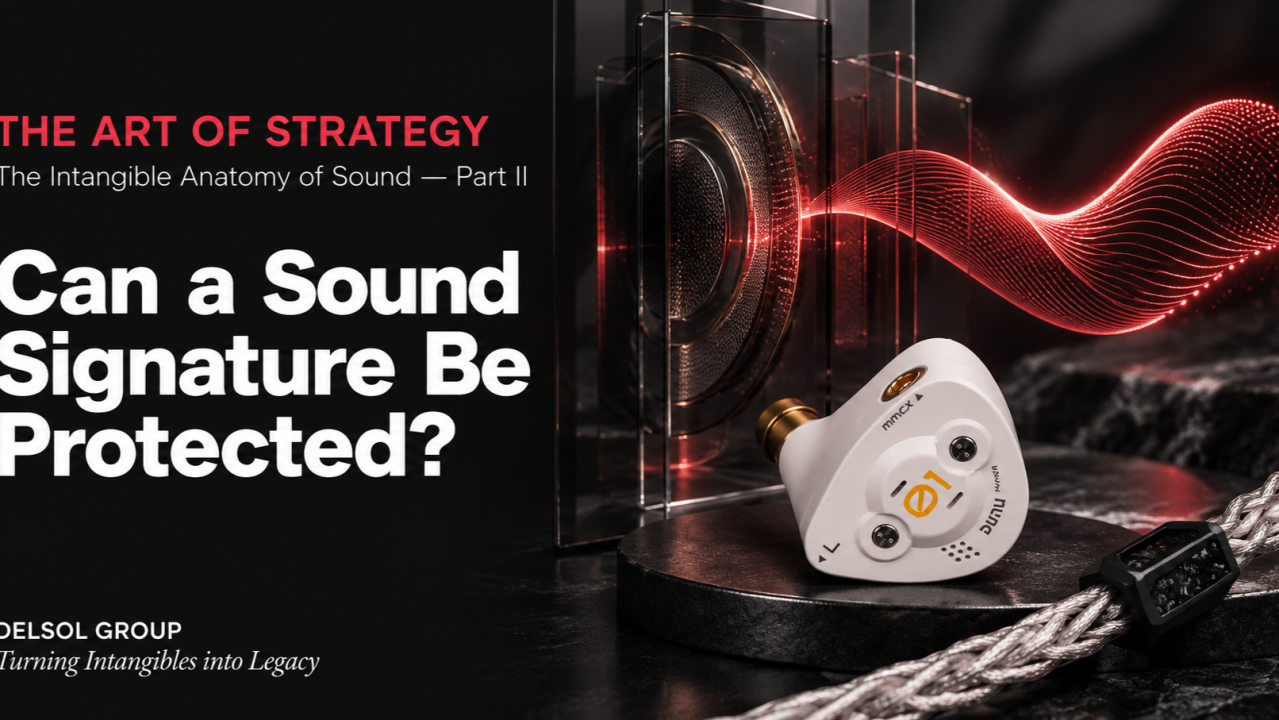
A few days ago, I looked at a pair of high-end in-ear monitors from an intellectual-property perspective.
The obvious question was: What is protected?
Patents. Trademarks. Design. Know-how. Technical information.
But there is a more difficult question.
And, strategically, it is a much more interesting one: What should be protected — and how?
Consider something as apparently simple as the way an earphone sounds.
Audiophiles regularly talk about a manufacturer's “house sound”:
- Warm.
- Neutral.
- Technical.
- Spacious.
- Intimate.
- Energetic.
- Relaxed.
Sometimes experienced listeners can identify the philosophy of a manufacturer without even seeing the product.
That raises a fascinating strategic question.
Can a sound signature be protected?
The answer is not a simple yes or no.
And that is exactly why it is interesting.
Start with the wrong question
The traditional IP question is often: Can we patent this?
That question matters. But it is incomplete.
The strategic question should be: How should we control the competitive advantage created by this?
Those are not the same thing.
Patent protection is one mechanism of control.
Trade secrecy is another.
Contracts are another.
Technical complexity can itself become a barrier.
Data can create another.
Speed, reputation, supplier relationships and accumulated know-how may create still others.
A good strategy therefore does not begin with a legal right.
It begins with the competitive advantage.
What creates a sound?
Take a sophisticated IEM such as the DUNU DK3001BD EA Limited Edition.
Its sound is not produced by one component.
DUNU describes the product as combining one dynamic driver, four balanced-armature drivers and four planar drivers through a dual-system, four-way crossover.
But even that description tells us very little about why it sounds the way it does.
Sound emerges from a system:
- Driver selection.
- Driver positioning.
- Acoustic chambers.
- Nozzle geometry.
- Damping.
- Airflow.
- Crossover points.
- Materials.
- Electrical behaviour.
- Phase.
- Manufacturing tolerances.
- Measurement methodology.
- Listening evaluation.
- Iteration.
The final tuning is therefore not a single invention.
It is the output of multiple interacting intangible assets.
That changes the protection question entirely.
What should be patented?
Patent protection is particularly useful when an innovation can be described as a technical solution to a technical problem and when preventing competitors from implementing that solution is strategically valuable.
In audio, this might concern:
- a new transducer architecture;
- a diaphragm structure;
- a pressure-control mechanism;
- a crossover topology;
- a mechanical arrangement;
- a connector;
- a particular acoustic chamber;
- a method of controlling resonance.
For example, patent filings associated with Dongguan-based Dadian entities have addressed hybrid driver arrangements and pressure management in earphone cavities.
These are technical solutions.
They can potentially be analysed, claimed and enforced.
But patenting creates a strategic trade-off.
A patent gives exclusivity. In exchange, you disclose the invention.
That exchange may be attractive. Or it may be exactly what you do not want.
What should remain secret?
Imagine that a manufacturer has spent years learning exactly how to tune several different driver technologies so that they behave as one coherent system.
Perhaps there is no single revolutionary invention.
Instead, competitive performance results from hundreds of small decisions:
- Damping values.
- Material choices.
- Assembly tolerances.
- Manufacturing sequences.
- Measurement techniques.
- Listening protocols.
- Selection criteria.
- Calibration processes.
- Supplier specifications.
Individually, none may justify a patent.
Together, however, they may form the company's most valuable knowledge.
This is the natural territory of trade secrets.
The strategic objective changes.
Instead of excluding competitors through a registered right, the company seeks to preserve an information asymmetry.
That means the real protection system is organisational:
- access control;
- confidentiality;
- documentation;
- employee policies;
- supplier agreements;
- digital security;
- segmentation of knowledge;
- contractual restrictions;
- internal culture.
A secret is not protected because somebody writes “confidential” on a PDF.
It is protected because the company behaves as though the information matters.
The paradox of measurement
Audio creates another strategic difficulty.
Many outputs can be measured:
- Frequency response.
- Distortion.
- Impedance.
- Phase behaviour.
A competitor can purchase the product, measure it and analyse it.
This raises a classic trade-secret question:If the result can be reverse-engineered, where should secrecy sit?
Perhaps not in the output.
Perhaps in the process.
A frequency-response curve may be visible. But the development process that produced it may not be reproducible.
The tuning target may be observable. The fastest path to achieving it may remain secret.
This distinction exists in many industries.
The customer sees the outcome.
The strategic asset is the capability that repeatedly produces the outcome.
And what about the “sound signature” itself?
This is where the discussion becomes more subtle.
A sound signature can become recognisable.
It can become associated with a company.
It can contribute to brand identity.
But that does not automatically mean it becomes a conventional monopoly right.
Instead, its value may emerge from the interaction between several forms of control:
- Technology helps create the sound.
- Trade secrets preserve the recipe.
- Data improves subsequent generations.
- Human capital carries the tuning expertise.
- Trademarks attach the experience to a name.
- Reputation converts that association into demand.
In other words: the sound itself may be difficult to own, while the system capable of repeatedly creating it can be strategically controlled.
That distinction is fundamental.
Protection and control are not the same
This leads to one of the principles I use frequently in IP strategy: Ownership is not the same as control.
A company might own a patent and still have little strategic control if competitors can easily design around it.
A company may own no patent over a particular process and nevertheless enjoy substantial control because the know-how is secret, distributed across specialised teams and extremely difficult to reproduce.
Similarly, a company may own a trademark while losing control of the reputation associated with it.
The strategist therefore needs to ask something broader than: “What do we own?”
The better question is: “What must remain under our control for the business model to remain defensible?”
The patent / secret decision
Imagine two technologies.
Technology A
Once a competitor sees the product, the solution becomes obvious.
Reverse engineering is easy.
The innovation can be clearly claimed.
Competitors are likely to copy it.
Patent protection may therefore be attractive.
Technology B
The competitive advantage lies in a complex manufacturing process.
The final product does not reveal the process.
Only a handful of employees understand the full methodology.
Keeping the knowledge secret may create protection that lasts far longer than a patent.
The correct answer is not ideological.
It is strategic.
There is no rule saying: Innovative technology → patent it.
The decision should depend on:
- detectability;
- reverse-engineering risk;
- design-around possibilities;
- technology lifecycle;
- enforcement prospects;
- market importance;
- disclosure cost;
- geographical scope;
- competitive behaviour; and
- how the technology contributes to value creation.
Collaboration makes the question harder
My DK3001BD limited edition introduces another layer because it was developed as a collaboration between DUNU and Effect Audio. DUNU presents the product as its first collaboration edition with Effect Audio.
Now imagine that the collaboration creates a new tuning:
- Who controls it?
- Who may reuse it?
- Who owns the measurement data?
- What happens if one partner later develops a similar product?
- What constitutes background IP?
- What constitutes foreground IP?
- Which improvements belong to whom?
- Who may disclose what?
At this point, contracts become part of the IP architecture.
Not merely legal paperwork.
Strategic infrastructure.
Build a control architecture
A mature company should therefore classify its innovation differently.
Not simply: Patentable / not patentable.
But perhaps:
- Patent: We disclose this because exclusivity is strategically more valuable than secrecy.
- Trade secret: We conceal this because competitors cannot easily reconstruct it.
- Contractual control: We allow another party to access it, but under defined conditions.
- Defensive publication: We disclose it because preventing competitors from patenting it matters more than exclusivity.
- Open ecosystem: We deliberately make it accessible because adoption creates more value than restriction.
- Brand association: We do not control the technology exclusively, but we want customers to associate the experience with us.
Now we are no longer managing patents.
We are designing a competitive-control architecture.
Strategy begins where legal categories end
The question “Can a sound signature be protected?” therefore leads to a more useful conclusion.
Perhaps the sound itself is not the principal asset.
Perhaps the strategic asset is the company's ability to create that sound:
repeatedly; reliably; at scale; across generations of products;
while making customers associate the experience with its brand.
And that capability may be protected not by one right, but by a combination of patents, trade secrets, contracts, data, human capital and reputation.
Which is why, in IP strategy, the most important question is rarely: What can we protect?
It is: What do we need to control?
And once that question is answered, the appropriate IP instruments become much easier to choose.
Next in the series: When Scarcity Becomes an Intangible Asset.