Dear Readers, Strategists and Game-Changers,
Hope you are doing great!
There is something economically strange about a limited-edition product.
A company develops something people want.
It has the ability to manufacture it.
Demand may exist for more.
And then the company deliberately decides: We will stop.
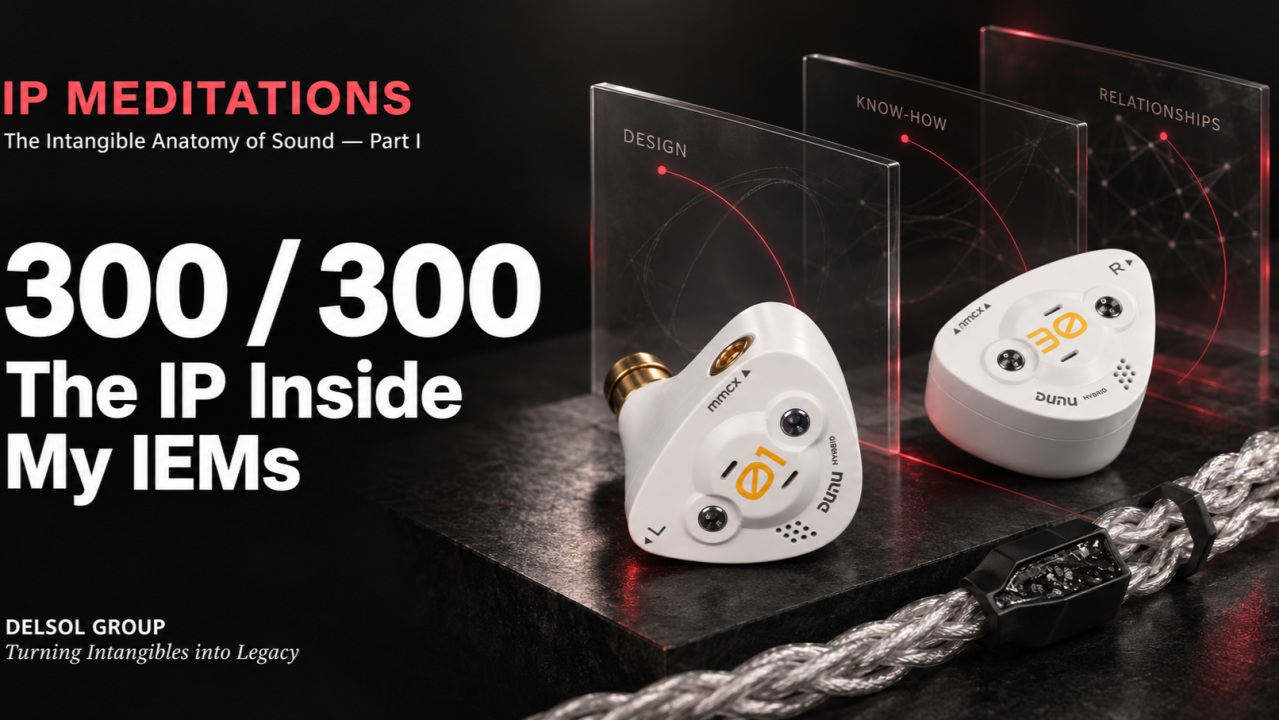
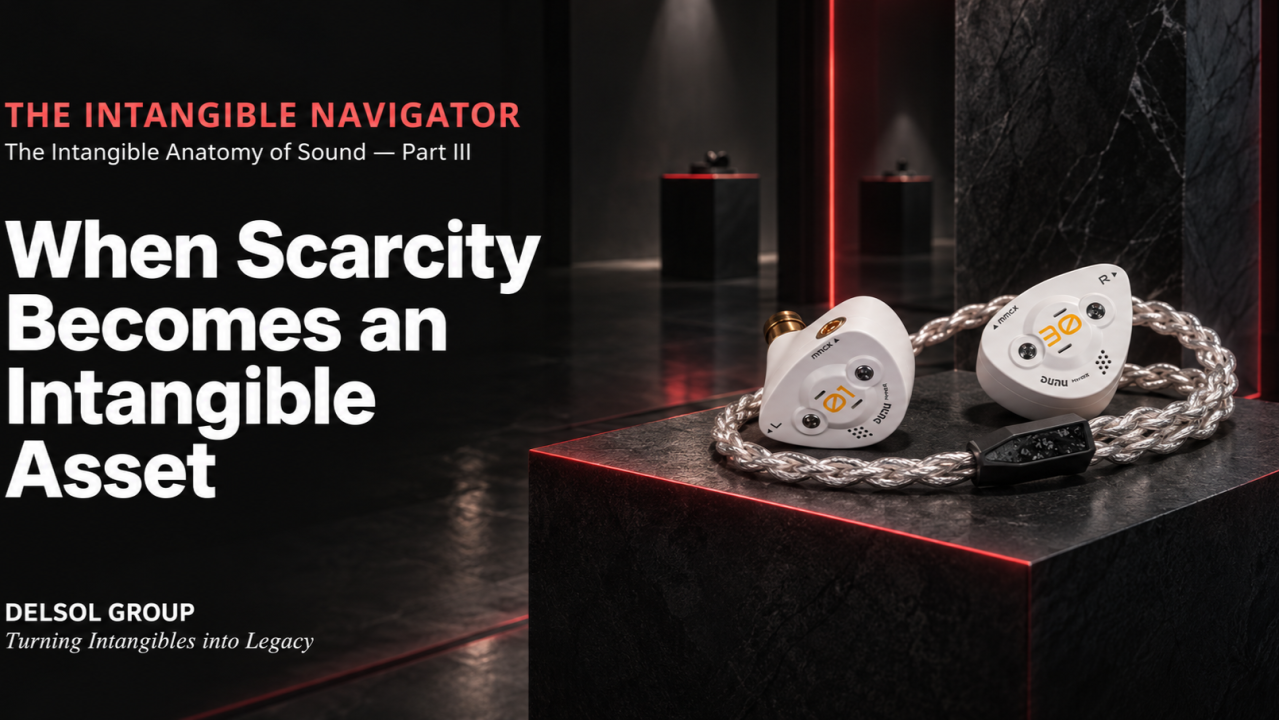
My DUNU DK3001BD x Effect Audio in-ear monitors provide a perfect example.
DUNU officially limited this collaboration to 300 units worldwide.
Why 300? Why not 500? Why not 3,000?
Why not manufacture as many as the market will absorb?
From a purely industrial perspective, scarcity can look inefficient.
From an intangible-assets perspective, however, scarcity can become extremely powerful.
Because customers do not purchase only physical functionality.
They also purchase meaning.
Scarcity is not intellectual property
Let us start with an important distinction.
Scarcity is not, by itself, an intellectual-property right.
No patent is created because only 300 products exist.
No trademark automatically gives its owner the right to limit supply.
No design right arises merely because production is small.
And yet scarcity can materially change how all those assets are perceived and monetised.
This is where intangible-asset strategy becomes broader than IP law.
The interesting question is not: “What legal right protects scarcity?”
It is: “How does scarcity change the economic behaviour of the intangible assets surrounding the product?”
The physical object has a ceiling
Consider the physical components of a premium earphone:
- Metal.
- Drivers.
- Magnets.
- Copper.
- Connectors.
- Packaging.
- Labour.
- Logistics.
Each has a cost.
Add them together and we obtain part of the economic structure of the product.
But this calculation will not explain the entire selling price.
And it certainly will not explain why one product becomes desirable while another technically comparable product does not.
Something else is happening.
The customer is also purchasing:
- engineering credibility;
- brand history;
- trust;
- a particular tuning philosophy;
- design;
- community recognition;
- the experience of ownership;
- and, in this case, exclusivity.
These elements have almost no physical mass.
Yet they can represent a substantial share of perceived value.
From utility to meaning
At the functional level, an IEM has a simple task.
Convert an electrical signal into sound.
If functionality were the only criterion, the market would be extremely rational.
Consumers would compare measurable performance and price.
They would then choose the most efficient combination.
But premium markets do not work this way.
A watch tells time.
A sports car transports a person.
A luxury handbag carries objects.
An audiophile IEM reproduces music.
Yet customers routinely pay far beyond the minimum cost required to fulfil those functions.
Why?
Because at some point, the object acquires meaning.
And meaning is intangible.
The scarcity multiplier
Scarcity can amplify that meaning.
Imagine two products that are technically identical.
Product A is manufactured without limitation.
Product B is restricted to 300 numbered examples.
Nothing about the acoustic performance necessarily changes.
But the customer experience may change considerably.
Product B now carries:
- exclusivity;
- a story;
- community membership;
- collectability;
- a moment in the brand's history;
- potential secondary-market significance;
- and the knowledge that availability cannot simply be reproduced on demand.
The physical product remains the same.
The intangible context around it changes.
This is why I would not classify scarcity itself as an intangible asset in the same way as a trademark or know-how.
I would instead describe it as an intangible-value amplifier.
It increases the economic effect of other assets.
Why collaboration matters
The limited-edition DK3001BD is also interesting because scarcity is combined with collaboration.
It is a DUNU × Effect Audio product.
That means the customer is not purchasing exposure to one brand ecosystem.
They are purchasing the intersection of two.
DUNU contributes its IEM architecture, engineering and product identity.
Effect Audio contributes its cable, its reputation and its own community.
DUNU identifies the limited model as using Effect Audio's Cadmus II cable and as the companies' first collaboration edition.
Strategically, collaboration can therefore create what we might call reputational recombination.
Brand A has an audience.
Brand B has another.
A joint product creates a new temporary territory between them.
This mechanism is extremely common in:
- fashion;
- watches;
- automotive;
- gaming;
- sports;
- music;
- movies;
- consumer electronics.
And increasingly, high-end audio.
Collaboration creates intangible optionality
The value of collaboration goes further than immediate sales.
It can generate new intangible assets:
- joint know-how;
- customer data;
- market intelligence;
- technical learning;
- cross-brand recognition;
- new distribution relationships;
- future collaboration opportunities;
- new product concepts.
A limited run can therefore function almost like an experiment.
Instead of simply asking: “How much revenue did these 300 units create?”
management should ask: “What new strategic options did this collaboration create?”
That question is much more interesting.
Perhaps the real return appears later.
Human capital sits behind everything
High-end products also remind us of another category of intangible asset that balance sheets often struggle to represent properly: Human Capital.
Somebody had to make hundreds of engineering decisions.
Somebody selected the drivers.
Somebody evaluated prototypes.
Somebody listened.
Somebody decided that one tuning was better than another.
Somebody knew what to change when measurements looked correct but the product still did not sound right.
This capability often exists partly in documents.
But much of it exists inside people.
Which means employee retention, knowledge transfer, documentation and culture become part of intangible-asset management.
Lose the right people and a company may still own all its patents.
But it may no longer know how to create the next generation of the product.
That is a very different type of risk.
Reputation is an asset with no registration number
Then there is reputation.
High-end audio is heavily influenced by specialist reviewers, communities, forums, measurements, enthusiasts and word of mouth.
Reputation can take years to build.
It can influence willingness to pay almost immediately.
And yet there is no single certificate saying: “This company owns 14.7 million euros of reputation.”
This is precisely why intangible assets are difficult to manage.
Many of the most valuable ones do not arrive with a registration number.
They must first be identified.
Then understood.
Then connected to the business model.
Scarcity without substance is dangerous
Of course, limiting something to 300 units does not automatically create value.
Scarcity works only if something worth wanting already exists.
Otherwise, the company has simply produced a small quantity of an unwanted product.
This distinction is crucial.
Scarcity can amplify:
- technology;
- brand;
- design;
- reputation;
- storytelling;
- community.
But it cannot replace them.
In luxury strategy, artificial scarcity unsupported by genuine desirability can even damage trust.
So the sequence matters.
First create meaning.
Then scarcity can magnify it.
Intangible assets behave as a system
This is where the example becomes useful far beyond audio.
Imagine the DK3001BD limited edition as a network.
At the centre is the physical product.
Around it sit several intangible assets:
- technology;
- patents;
- know-how;
- design;
- brand;
- human capital;
- supplier relationships;
- community;
- reputation;
- collaboration rights;
- data;
- scarcity.
None of them operates independently.
Better technology strengthens reputation.
Reputation strengthens brand.
Brand makes scarcity credible.
Scarcity increases desirability.
Desirability attracts collaboration partners.
Collaboration creates new knowledge.
New knowledge feeds the next product.
This is not a list.
It is a system.
And that is how companies should increasingly think about intangible assets.
From accounting value to strategic value
Traditional accounting naturally focuses on assets that can be recognised and measured according to defined rules.
But strategic management has a different problem.
Management needs to understand assets even when they do not appear clearly on the balance sheet.
What knowledge creates revenue?
What reputation enables premium pricing?
Which people hold critical capabilities?
Which relationships would be difficult to reproduce?
Which data improve future products?
Which assets reinforce each other?
Which asset, if lost tomorrow, would weaken the business most?
Those questions are not primarily accounting questions.
They are strategic questions.
The invisible architecture of value
When somebody purchases a limited-edition high-end product, the transaction appears simple.
Money moves in one direction.
A physical object moves in the other.
But beneath that transaction sits something far more complex: An architecture of Intangible Assets amplified by scarcity.
This invisible architecture explains why two objects containing similar quantities of metal, copper and electronics can have radically different economic value.
The difference is often not in what the customer can touch.
It is in everything surrounding it.
Navigating intangible value
This is why I increasingly think companies should stop asking only: “What intangible assets do we own?”
and start asking: “How do our intangible assets interact to create value?”
Because patents do not create value alone.
Brands do not create value alone.
Know-how does not create value alone.
People do not create value alone.
Their power comes from the way they reinforce one another.
My pair of IEMs happens to be one of only 300.
But the interesting number is not 300 (even if it was part of the gift from my Wife celebrating my recognition as one of 300 World's Leading IP Strategists).
The interesting question is why being one of 300 matters at all.
The answer is intangible.
And that is precisely the point.