Dear Readers, Strategists and Game-Changers,
Hope you are doing great!
Imagine buying a company.
You receive the financial statements.
Buildings. Equipment. Cash. Receivables. Liabilities.
Everything appears orderly.
Now imagine that, the morning after the acquisition, something strange happens.
The company's best engineers leave.
Its customer relationships disappear.
Its reputation collapses.
Its proprietary dataset is deleted.
Its source code becomes inaccessible.
Its brand loses credibility.
Its suppliers terminate key relationships.
Its critical know-how walks out through the front door.
The buildings are still there. The equipment is still there. The cash is still there.
But would you still believe you had purchased the same company?
Of course not.
And therein lies one of the most fascinating paradoxes of the modern economy.
Some of the assets most responsible for enterprise performance can be among the least obvious when we look at the company through a traditional accounting lens.
WIPO describes intangible assets as deriving value from ideas, knowledge, innovation and reputation and notes that they are often invisible in financial reporting despite their importance to innovation, productivity and growth.
This does not mean accounting is wrong.
Accounting has a different purpose.
But management cannot afford to confuse what accounting recognises with what the business depends upon.
The company behind the company
Walk into almost any modern technology company and ask: “What makes this business valuable?”
You are unlikely to hear:
our desks. our laptops. our office building.
Instead you will hear:
our technology. our engineers. our reputation. our algorithms.
our customer relationships. our software. our patents.
our data. our culture. our community.
our know-how. our ability to innovate.
These assets form what I think of as the company behind the company.
The visible organisation sells products and services.
The invisible organisation creates the capacity to continue doing so better than competitors.
Not everything intangible is IP
It is important to distinguish intangible assets from formal intellectual property rights.
Patents, trademarks, registered designs and copyrights belong to the IP universe.
But enterprise value can also depend on assets that are more difficult to place inside a conventional IP portfolio.
Customer relationships.
Organisational knowledge.
Reputation.
Culture.
Datasets.
Processes.
Contractual positions.
Supplier networks.
Human capabilities.
Strategic partnerships.
Software systems.
Goodwill.
Future optionality.
Some have legal protection. Some have contractual protection.
Some depend on secrecy. Some depend on organisational discipline.
Some cannot truly be “owned” in the traditional sense but can nevertheless be cultivated and governed.
This is precisely why an intangible-asset strategy must be broader than traditional IP administration.
Identification comes before valuation
Companies may ask: “How much are our intangible assets worth?”
A legitimate question. But usually too early.
Before valuation comes identification.
You cannot meaningfully value an asset you have not clearly described.
WIPO's guidance on IP valuation similarly emphasises identifiability, evidence of existence and the relationship between the asset and economic benefits. It also notes that different valuation approaches may be appropriate depending on the asset, context and available information.
So begin with something simpler.
What exists?
Who controls it?
Why does it matter?
What business capability does it support?
What would happen if it disappeared?
Who else could reproduce it?
How quickly?
Suddenly, an intangible asset inventory becomes a strategic map.
The dependency test
One of my favourite questions when analysing an intangible asset is: “What breaks if this disappears tomorrow?”
Suppose one engineer leaves.
Nothing unusual.
But suppose that engineer is the only person who knows how a critical production process works.
That person is no longer merely an employee from a strategic perspective. The organisation has a knowledge concentration risk.
Suppose one supplier disappears.
If alternatives exist, the impact may be modest.
But if ten years of optimisation make the relationship unique, there may be substantial relational capital embedded in it.
Suppose the brand receives a severe reputational shock.
The physical assets remain unchanged.
But customer willingness to buy may change overnight.
The dependency test reveals something important: value and vulnerability often inhabit the same asset.
An intangible asset can be valuable and dangerous simultaneously
Consider a large proprietary dataset.
It can improve models.
Accelerate R&D.
Reveal customer behaviour.
Create differentiation.
Support new products.
It can therefore be extraordinarily valuable.
But the same dataset may create cybersecurity risk, privacy obligations, contractual exposure and reputational risk.
Or consider a superstar employee.
Their expertise generates enormous value.
But excessive dependence on one individual creates fragility.
Or a celebrated brand.
It creates pricing power and trust.
But the stronger the brand, the greater the potential damage caused by reputational failure.
Good governance therefore asks two questions simultaneously:
How does this asset create value?
and
How can this asset destroy value?
The five dimensions I would map
For every strategic intangible, I would examine five dimensions.
First, contribution.
What does this asset actually do for the business?
Create revenue?
Reduce cost?
Accelerate innovation?
Create exclusivity?
Increase customer retention?
Reduce risk?
Open markets?
Second, control.
Does the company genuinely control the asset?
Who owns the relevant IP?
What do employment agreements say?
What about contractors?
Joint-development partners?
Universities?
Suppliers?
Third, defensibility.
What prevents others from reproducing it?
Patent rights?
Secrecy?
Time?
Data?
Network effects?
Brand?
Regulation?
Contracts?
Execution complexity?
Fourth, fragility.
What could cause the asset to lose value?
Employee departure?
Disclosure?
Patent expiration?
Technological substitution?
Cyberattack?
Regulatory change?
Customer concentration?
Fifth, optionality.
What could this asset enable that the company is not yet monetising?
Licensing?
New markets?
Partnerships?
Spin-offs?
Financing?
Cross-selling?
Future product families?
This last category is frequently overlooked.
Management often asks what an asset is worth today.
Strategy also asks: What might this asset allow us to become tomorrow?
The valuation problem is evolving
The world of valuation is itself adapting to these realities.
In 2026, WIPO highlighted the growing importance of emerging intangible assets including data, algorithms and trade secrets, noting the particular challenges they create for valuation and the need for transparency, accountability and professional judgement.
This matters.
Because attempts to assign precise numbers to immature intangible assets can create false confidence.
A valuation is not reality.
It is a structured interpretation of available information under a defined purpose.
Different valuations may be appropriate for financing, licensing, litigation, M&A, transfer pricing or strategic management.
The objective is not necessarily to discover one magical “true value.”
It is to understand the economics of the asset well enough to make better decisions.
From invisible balance sheet to management dashboard
Imagine instead that every board received an Intangible Asset Dashboard.
Not merely a list of patents.
A map showing:
- which assets create strategic differentiation,
- which assets drive revenue,
- which are concentrated in individual people,
- which rely on secrecy,
- which face expiry,
- which are weakly protected,
- which relationships create leverage,
- which data assets exist,
- which assets could be monetised, and
- which vulnerabilities require immediate action.
Suddenly the conversation changes.
IP ceases to be a legal cost centre.
Knowledge management ceases to be administrative.
Brand ceases to belong only to marketing.
Data ceases to belong only to IT.
People cease to appear only as payroll.
They become parts of the same system: the enterprise's intangible value architecture.
The finance world is beginning to notice
There is also a larger consequence.
Businesses require capital.
Historically, finance has been comfortable with physical collateral because physical assets are comparatively straightforward to identify and recover.
Yet many modern companies own relatively little physical infrastructure compared with the knowledge and IP on which their future depends.
WIPO is actively examining ways to bring IP-backed and intangible-asset finance further into mainstream financial practice.
This creates an important strategic implication.
The better companies become at identifying, documenting, protecting and explaining their intangible assets, the easier it may become for investors, lenders, acquirers and partners to understand what they are actually financing.
Governance therefore becomes part of value communication.
Look beneath the numbers
Financial statements remain essential.
But when analysing a modern company, they are not the end of the investigation.
They are the beginning.
The strategist must look beneath them.
What knowledge exists?
What relationships exist?
What rights exist?
What data exists?
What reputation exists?
What capabilities exist?
What has taken ten years to build but could disappear in ten days?
What could competitors buy?
And what could they never simply buy, because it would have to be learned?
That is where some of the most interesting questions about enterprise value begin.
The final thought
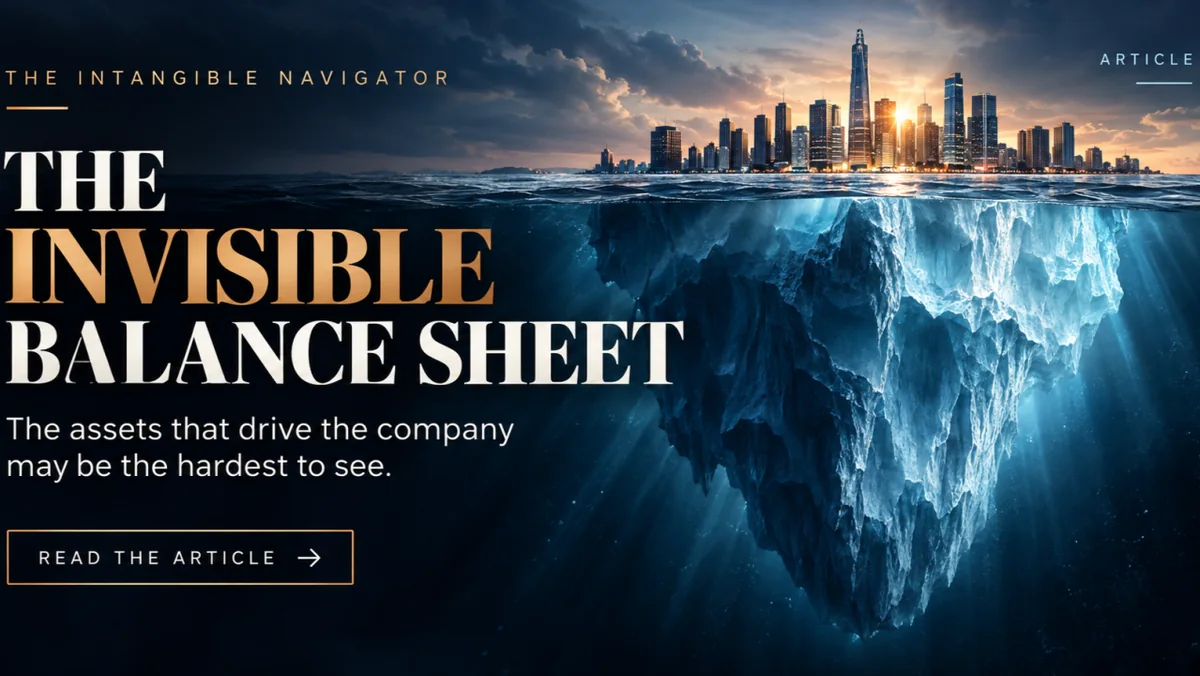
Every company has a visible balance sheet.
But every knowledge-intensive company also has another one.
An invisible one.
It contains things that may be difficult to measure precisely.
Some may never appear individually in financial accounts.
Some cannot easily be sold separately.
Some are fragile.
Some are deeply interconnected.
But they shape the future of the organisation nonetheless.
The responsibility of management is therefore not necessarily to put a price tag on everything.
The first responsibility is simpler: See it.
Then:
Understand it.
Govern it.
Protect it.
Develop it.
Use it.
Because an asset does not stop being strategically important merely because it is difficult to see.
Sometimes, the invisible assets are precisely where the company resides.