The quantum race will not be won by the country with the largest number of qubits. It will be won by the country—and the companies—that control the knowledge, infrastructure, standards, supply chains and markets surrounding them.
Two signatures. One strategic doctrine.
Dear Readers, Strategists and Game-Changers,
Hope you are doing great!
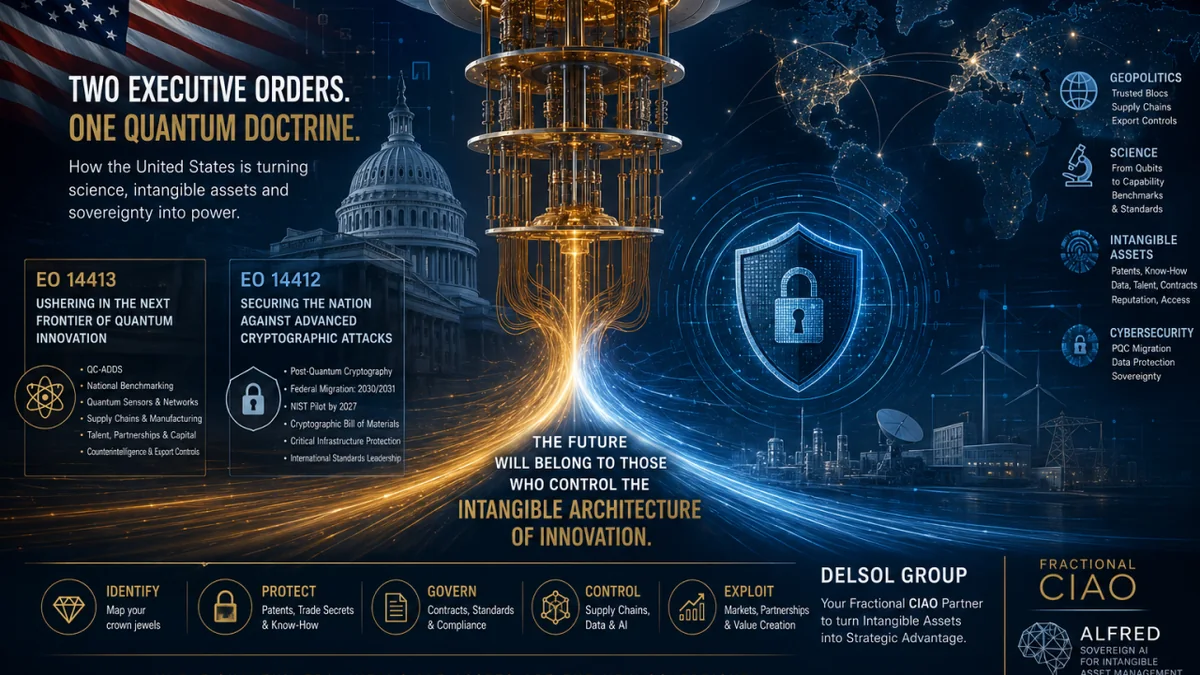
On 22 June 2026, President Donald Trump signed two Executive Orders that may prove far more consequential than their technical titles suggest:
- Executive Order 14413, Ushering in the Next Frontier of Quantum Innovation;
- Executive Order 14412, Securing the Nation Against Advanced Cryptographic Attacks.
At first sight, the first Order is about accelerating quantum innovation, while the second concerns migration to post-quantum cryptography.
But read together, they reveal something much larger.
The United States is assembling a complete architecture of quantum power.
One Executive Order seeks to develop, manufacture, benchmark, commercialise and protect advanced quantum technologies. The other seeks to defend sensitive information, critical infrastructure and the digital economy against the future cryptographic consequences of quantum computing.
The strategic equation is clear:
Build the quantum capability. Protect the knowledge that makes it possible. Secure the data it may threaten. Control the supply chains that sustain it. Shape the standards that govern it. Organise allies, capital and markets around it.
This is not merely a science policy.
It is an industrial policy, a national-security policy, a cybersecurity policy, a standards policy, a talent policy and—perhaps most importantly—an intangible-assets policy.
For governments, research institutions, investors and technology companies, the message is unmistakable: quantum technology has entered a new phase in which scientific excellence alone is no longer sufficient.
The decisive question is becoming:
Who controls the intangible architecture surrounding the science?
Executive Order 14413: from quantum research to a full-stack industrial strategy
Executive Order 14413 begins with a strong political premise: the United States must maintain a strategic technical advantage in quantum information science and technology, or QIST.
Its scope extends across:
- quantum computing;
- quantum sensing;
- quantum networking;
- manufacturing;
- commercialisation;
- national-security applications;
- workforce development;
- supply-chain resilience;
- international cooperation;
- export controls;
- investment restrictions;
- and counterintelligence.
This breadth matters.
For years, public discussions around quantum technology have often been reduced to a race for qubit counts, error rates or fault-tolerance milestones. The Executive Order adopts a more mature view: no quantum computer exists in isolation.
A commercially and strategically relevant quantum capability depends on an entire ecosystem of enabling technologies and intangible assets:
- cryogenic systems;
- control electronics;
- lasers and photonics;
- semiconductor fabrication;
- materials and processes;
- error-correction methods;
- compilers and algorithms;
- calibration techniques;
- benchmarking protocols;
- proprietary datasets;
- manufacturing know-how;
- specialist talent;
- and access to trusted customers and infrastructure.
The Order therefore moves beyond “fund more research” and begins to organise the conditions through which research becomes deployable power.
A national computer for scientific discovery
At the centre of the Order is the creation of the Quantum Computer for Application Development and Discovery Science effort, or QC-ADDS.
Its objective is to pursue a quantum computer capable of enabling transformative scientific applications beyond the capabilities of current classical computing systems, with the intention of installing at least one such system at a Department of Energy facility and, where possible, making it available to the scientific community.
This is scientifically significant.
The objective is not simply to construct a larger machine. It is to connect quantum computing with economically and scientifically meaningful applications.
Within 90 days, the Department of Energy must identify technical specifications for a QC-ADDS capable of supporting transformative scientific applications that are:
- beyond current classical-computing capabilities; and
- on a path towards economically significant uses.
The government is therefore attempting to define a bridge between scientific advantage and economic relevance.
This may influence which technical architectures receive funding, which performance metrics become authoritative, which companies gain access to public infrastructure and which applications attract early procurement.
It can also shape private investment.
Once a government identifies particular specifications, benchmarks and application categories as strategic, those choices can influence market expectations well beyond the public sector.
Benchmarking becomes an instrument of power
The Order also calls for the establishment of a national centre to develop the tools and capabilities required to assess the performance of quantum-computing systems.
This may appear to be a technical matter. It is not.
Benchmarking determines what counts as progress.
The entity that defines how quantum systems are evaluated can influence:
- public funding decisions;
- procurement requirements;
- investor perceptions;
- commercial claims;
- technology comparisons;
- technical standards;
- and eventually market access.
A company may possess an excellent technology but still lose strategic ground if its performance cannot be demonstrated according to the metrics adopted by governments, customers or standards bodies.
Metrology, testing protocols and benchmarks are therefore not merely scientific tools. They are strategic intangible assets.
They establish the language through which value is recognised.
Sensors and networks may reach deployment first
The Order also avoids the common mistake of treating quantum technology as synonymous with quantum computing.
It requires the identification of at least three next-generation quantum-sensor projects to be prioritised for deployment by 30 September 2028. It also requires five-year plans addressing quantum sensing, imaging, networking, timing and distributed quantum computing.
This is important because some of the earliest strategically meaningful quantum deployments may not come from universal fault-tolerant computers.
They may come from:
- precision navigation;
- gravity sensing;
- underground and underwater detection;
- medical imaging;
- materials characterisation;
- timing systems;
- space applications;
- communication infrastructure;
- and defence sensing.
The commercialisation pathways, IP landscapes and supply chains for these technologies differ substantially from those of quantum computing.
There is no single “quantum industry.” There are multiple overlapping technology industries, each with its own protection strategies, regulatory environment, market structure and geopolitical exposure.
Manufacturing and supply chains enter the centre of quantum policy
Executive Order 14413 requires the analysis and strengthening of quantum supply chains and calls for measures supporting quantum-enabling technologies and domestic manufacturing.
This marks a shift from scientific sovereignty to industrial sovereignty.
A nation may host world-class researchers and still remain dependent on foreign suppliers for:
- high-purity materials;
- specialised substrates;
- photonic components;
- cryogenic equipment;
- lasers;
- microwave electronics;
- control chips;
- fabrication facilities;
- packaging;
- or precision measurement tools.
In such a situation, scientific leadership does not automatically translate into strategic autonomy.
The same is true for companies.
A business may own valuable patents but remain vulnerable because a critical component is available from only one supplier, because a fabrication process is performed in a sensitive jurisdiction, or because essential know-how resides with a small number of employees or external partners.
The Order recognises that quantum competitiveness depends on the ability to control—or at least secure access to—the full chain of value creation.
Protecting quantum technology itself
The Order calls for expanded counterintelligence capabilities and improved coordination between government, industry and academia concerning threats to the quantum ecosystem.
This places research security, trade secrets and knowledge leakage directly within the national-security perimeter.
Quantum organisations will increasingly need to distinguish between information that should be:
- patented and disclosed;
- maintained as a trade secret;
- shared within a trusted consortium;
- restricted contractually;
- controlled under export rules;
- compartmentalised internally;
- or excluded from external AI and cloud systems.
This is no longer a simple patent-filing question.
It is an information-governance question.
And in advanced science, the most valuable asset may not be the invention described in a patent. It may be the undocumented experimental knowledge required to reproduce it:
- the calibration sequence;
- the fabrication tolerance;
- the source of noise;
- the rejected design paths;
- the training data;
- the test environment;
- the integration method;
- or the tacit knowledge of a small technical team.
These assets are frequently more difficult to identify and protect than a formal patent application.
They may also be more valuable.
Executive Order 14412: the cryptographic clock is already ticking
The second Executive Order addresses the threat that sufficiently capable quantum computers could pose to widely used public-key cryptography.
The scientific distinction is essential: Post-quantum cryptography does not require a quantum computer.
It consists of cryptographic algorithms designed to resist attacks conducted using either classical or quantum computers.
The urgency comes partly from the risk commonly described as “harvest now, decrypt later.”
An adversary does not need a cryptographically relevant quantum computer today. It may collect encrypted information now, retain it and attempt to decrypt it when the necessary computing capability becomes available.
This means that the relevant question is not merely:
When will a quantum computer be capable of breaking current encryption?
The better question is:
For how long must the information remain confidential?
Technical data collected in 2026 may still be commercially or strategically valuable in 2036.
This is especially true for:
- defence technologies;
- pharmaceutical research;
- genomic information;
- critical-infrastructure designs;
- government communications;
- semiconductor processes;
- quantum architectures;
- industrial recipes;
- long-term commercial negotiations;
- and patentable R&D that has not yet been publicly disclosed.
Concrete federal deadlines
Executive Order 14412 imposes a structured migration programme for high-value assets and high-impact federal systems.
It requires:
- the designation of a PQC migration lead within each relevant agency;
- transition to post-quantum cryptography for key establishment by 31 December 2030;
- transition to post-quantum digital signatures by 31 December 2031;
- a NIST pilot migration project to be completed by 31 December 2027;
- and continuing assistance for critical-infrastructure operators.
The Order also requests public guidance on the minimum elements of a Cryptographic Bill of Materials, or CBOM.
A CBOM is intended to identify the cryptographic assets used within hardware or software.
This is strategically comparable to the growing use of Software Bills of Materials in cybersecurity: an organisation cannot manage a cryptographic migration if it does not know where vulnerable cryptography is embedded.
The same principle applies to intangible assets more broadly:
You cannot protect, migrate, license, value or strategically exploit assets that you have never properly identified.
From government migration to market transformation
The direct legal obligations of the Executive Order primarily concern the federal administration and its agencies. It is not a general law immediately imposing the same deadlines on every private company.
However, its commercial consequences are likely to extend much further.
Federal procurement requirements can influence technology markets. So can:
- NIST standards;
- validation programmes;
- government purchasing;
- cloud-service requirements;
- critical-infrastructure guidance;
- insurance expectations;
- contractual warranties;
- investor due diligence;
- and multinational supply-chain requirements.
Companies selling software, hardware, cloud services, cybersecurity products or critical-infrastructure solutions into the United States may increasingly be asked to demonstrate:
- cryptographic agility;
- visibility over embedded cryptographic components;
- transition plans;
- support for NIST-approved algorithms;
- and long-term data-protection strategies.
Post-quantum readiness may therefore become not only a cybersecurity matter, but also a criterion of commercial credibility.
The scientific reading: the shift from qubits to capability
The two Orders reveal a more sophisticated understanding of the quantum transition.
Scientific progress must become demonstrable
The creation of national evaluation capabilities indicates that performance claims will face growing scrutiny.
Quantum advantage cannot remain a marketing label. It must become:
- measurable;
- reproducible;
- independently assessable;
- application-specific;
- and economically meaningful.
This will affect not only technical roadmaps but also patent drafting and investment narratives.
A patent portfolio built around broad architectural concepts may be insufficient if the company cannot demonstrate control over the enabling know-how required to achieve the claimed performance.
Conversely, a company with modest patent numbers but deep control over calibration, fabrication, integration and error mitigation may possess a much stronger strategic position than a superficial portfolio analysis would suggest.
Quantum value is system-level value
A functioning quantum system is an accumulation of interdependent technologies.
The intellectual property may be distributed across:
- hardware;
- firmware;
- control systems;
- software;
- algorithms;
- interfaces;
- manufacturing processes;
- packaging;
- error correction;
- and application workflows.
This creates complex freedom-to-operate and ownership questions.
A company may own the core qubit architecture while depending on third-party rights for control electronics, fabrication, readout, packaging or software.
The resulting product may sit at the intersection of dozens of patent portfolios and hundreds of secret know-how elements.
Quantum IP strategy must therefore be designed at the system level, not simply invention by invention.
Quantum computing and PQC are connected but distinct
Executive Order 14413 seeks to increase quantum-computing capability. Executive Order 14412 seeks to reduce the cryptographic vulnerability created by that progress.
This is a deliberate dual strategy:
- accelerate the offensive and productive capability;
- reduce the defensive exposure.
The existence of these two parallel policies does not prove that a cryptographically relevant quantum computer is imminent.
It does demonstrate that the cost of waiting for certainty is considered unacceptable.
That is a lesson private organisations should understand.
Strategic readiness does not require certainty about the exact date of technological disruption. It requires comparing the cost of early preparation with the consequences of being too late.
The geopolitical reading: the emergence of trusted quantum blocs
Executive Order 14413 repeatedly connects quantum development with international alliances, strategic markets, trusted capital, supply-chain security, investment restrictions and export controls.
The United States is not seeking scientific self-sufficiency in complete isolation.
It is seeking to organise an ecosystem of like-minded countries around American strategic interests.
This points towards a world of trusted quantum blocs.
Within such blocs, there may be greater circulation of:
- talent;
- capital;
- components;
- research partnerships;
- technical data;
- procurement opportunities;
- and standards.
Outside them, access may become more restricted.
Markets and capital become geopolitical instruments
The Order seeks to ensure that American quantum companies have access to strategic markets and capital from like-minded countries.
This shows that foreign investment is no longer viewed solely as a financial matter.
The identity, jurisdiction and influence of investors can affect:
- regulatory approval;
- access to government programmes;
- eligibility for defence contracts;
- export-control exposure;
- collaboration opportunities;
- and the perceived trustworthiness of the company.
For quantum startups, the cap table may therefore become a geopolitical asset—or a geopolitical liability.
A funding round that appears attractive in purely financial terms may later restrict access to sensitive projects or strategic customers.
Intangible-asset strategy must consequently be connected with corporate structure, investment strategy and market-entry planning.
International collaboration will require stronger Intangible Assets architecture
Quantum science depends heavily on international and interdisciplinary collaboration.
But collaboration creates friction around:
- background IP;
- foreground IP;
- jointly developed inventions;
- publication rights;
- access rights;
- improvements;
- licensing fields;
- data ownership;
- source-code access;
- trade secrets;
- export controls;
- and post-project exploitation.
When public institutions, universities, startups, industrial groups and defence actors participate in the same ecosystem, these questions become even more complex.
A poorly designed consortium agreement can destroy years of scientific and commercial value.
A company may contribute its most valuable know-how to a collaboration and later discover that:
- ownership of improvements is unclear;
- exclusivity is impossible;
- publication occurred too early;
- patent rights were lost;
- or commercial use depends on another participant’s consent.
In a geopolitically sensitive field, collaboration agreements are not administrative documents.
They are instruments of sovereignty.
Standards will determine access to the future market
Executive Order 14412 promotes international adoption of NIST-approved post-quantum algorithms. Executive Order 14413 encourages standards adoption throughout the quantum ecosystem.
This is standards diplomacy.
The country whose technical standards become internationally dominant can influence:
- product design;
- interoperability;
- certification;
- procurement;
- compliance;
- licensing;
- and market access.
Companies must therefore decide whether they will merely comply with standards or participate in shaping them.
Standards participation may create important strategic positions through:
- early access to technical discussions;
- influence over specifications;
- standards-essential patents;
- interoperability knowledge;
- certification expertise;
- and relationships with regulators and industrial partners.
The most valuable IP strategy is not always to patent what the market already needs.
Sometimes it is to help define what the market will be required to need.
The intangible-assets reading: the invisible battlefield
The two Executive Orders confirm a fundamental reality: Quantum power is largely built from intangible assets.
Physical infrastructure matters, but its strategic value comes from the knowledge embedded within it.
The quantum intangible stack includes at least eight layers.
1. Patents
Patents can protect technical architectures, devices, methods, materials, algorithms with technical effects, manufacturing processes, control systems and applications.
But patent quantity alone says little about strategic strength.
The relevant questions are:
- Does the portfolio cover commercially important implementations?
- Does it block competitors or merely decorate the company?
- Is it aligned with the technical and business roadmap?
- Does it cover enabling technologies and integration points?
- Is it enforceable in the markets that matter?
- Does the company possess freedom to operate?
2. Trade secrets and know-how
Experimental knowledge, calibration methods, fabrication parameters, negative results and integration practices may never appear in patents.
These assets require:
- classification;
- access controls;
- internal documentation;
- contractual protection;
- secure processing environments;
- evidence of protective measures;
- and continuity plans when key employees leave.
A trade secret is not created merely by labelling a document “confidential.”
It exists because the organisation behaves consistently as though the information is valuable and secret.
3. Software, algorithms and data
Quantum value increasingly depends on classical and hybrid software:
- orchestration tools;
- compilers;
- optimisation methods;
- error-mitigation techniques;
- control software;
- simulation environments;
- and application-specific workflows.
Training data, experimental datasets and system-performance data can become critical competitive assets.
Their ownership, provenance, licensing and security must be managed from the beginning.
4. Standards, benchmarks and metrology
The ability to define or satisfy a benchmark can be as valuable as ownership of a technical component.
Standards influence what customers buy. Benchmarks influence what investors believe. Certification influences what governments permit.
These positions must be treated as strategic assets.
5. Human capital
Quantum expertise remains scarce and concentrated.
The knowledge held by key scientists and engineers may exceed the value captured in formal documentation.
Recruitment, retention, incentives, non-disclosure obligations, invention-assignment provisions and knowledge-transfer processes are therefore central components of IP strategy.
6. Contractual rights
A company may not own every technology it requires.
Its strategic position may instead depend on contractual rights to:
- use;
- modify;
- sublicense;
- manufacture;
- access data;
- obtain improvements;
- enter specific fields;
- or operate in specific territories.
Contractual architecture can determine whether an innovation is commercially deployable.
7. Cryptographic and information assets
Cryptographic dependencies, key-management systems, identity mechanisms, digital signatures and protected data are themselves part of the intangible infrastructure of a company.
PQC migration must be prioritised according to the value and useful life of the information being protected.
Not every dataset carries the same strategic risk.
8. Ecosystem access and reputation
Access to trusted suppliers, strategic investors, research facilities, public programmes and international partnerships can become an intangible competitive advantage.
Trust is increasingly a market-access asset.
Losing that trust can be more damaging than losing a single patent.
What boards, investors and technology leaders should do now
These Executive Orders should not trigger panic. They should trigger governance.
Every organisation operating in quantum technology—or in industries likely to be transformed by it—should consider at least seven actions.
First: map the crown jewels
Identify the technical, scientific, commercial and informational assets whose loss would materially damage the organisation.
This must include more than registered IP.
Second: connect IP strategy with the technology roadmap
Determine which elements should be patented, retained as trade secrets, published, standardised, licensed or shared through controlled collaboration.
Protection decisions should follow business objectives, not habit.
Third: review collaboration architecture
Audit university agreements, consortium arrangements, joint-development contracts, supplier relationships and public-funding obligations.
Confirm ownership of background IP, foreground IP, improvements, data and commercialisation rights.
Fourth: conduct supply-chain and jurisdictional mapping
Identify single-source dependencies, sensitive jurisdictions, foreign-investment exposure and technologies that may be affected by export controls or procurement restrictions.
Fifth: assess cryptographic exposure
Create an inventory of critical systems, data-retention horizons, cryptographic components and contractual cybersecurity obligations.
The transition should be prioritised according to the value and lifespan of the protected information.
Sixth: secure the AI knowledge layer
Scientists and engineers increasingly use generative AI to analyse data, draft code, summarise research and develop ideas.
This creates a new leakage surface.
An organisation may formally protect its patents and trade secrets while allowing its most valuable knowledge to pass through external AI platforms outside its effective control.
Quantum sovereignty without AI sovereignty is incomplete.
Seventh: establish executive ownership
These subjects cannot remain fragmented between the patent attorney, CTO, CIO, cybersecurity team, external counsel, research director and business-development function.
Someone must maintain the integrated view.
That is the role of an executive intangible-assets function.
From IP management to a Fractional CIAO function
At DELSOL Group, we do not treat intellectual property as an isolated filing activity.
Patents are essential, but they are only one component of the organisation’s strategic capital.
Our Fractional Chief Intangible Assets Officer—Fractional CIAO—function provides companies with an internal, executive-level capability to identify, protect, structure, govern and exploit their full portfolio of intangible assets.
The Fractional CIAO works across:
- patents;
- trade secrets;
- know-how;
- software;
- data;
- contracts;
- brands;
- standards;
- talent;
- partnerships;
- and technology capital.
The function connects these assets with:
- the scientific roadmap;
- the product roadmap;
- financing;
- market access;
- business development;
- partnerships;
- cybersecurity;
- and geopolitical exposure.
This does not replace external patent or legal counsel.
It complements and coordinates them.
The relationship is similar to that between a CFO and an accounting firm: the external firm provides specialised services, while the executive function maintains strategic ownership, prioritisation, coordination and continuity inside the business.
For quantum companies, we combine this function with deep scientific and sector-specific understanding through our Fractional Quantum CIPO/CIAO approach.
A quantum IP strategy cannot be credible without understanding the underlying physics, system architecture and commercialisation challenges.
ALFRED: protecting the environment in which knowledge is processed
The Executive Orders also reinforce the importance of what we describe as the organisation’s knowledge layer.
Protecting a patent portfolio is not sufficient when confidential R&D information is continuously processed through AI systems, cloud platforms and external tools.
This is why DELSOL AI , in collaboration with HMS DELSOL , developed ALFRED.
ALFRED is a sovereign, agentic AI environment designed for the strategic management of:
- R&D information;
- trade secrets;
- confidential technical knowledge;
- business-sensitive data;
- and related intangible assets.
Depending on the architecture selected, ALFRED can operate on controlled, local or on-premise infrastructure, enabling organisations to benefit from advanced AI while retaining control over where their most valuable knowledge is processed.
ALFRED does not replace cryptographic engineering or cybersecurity specialists.
It addresses another critical layer: the governance, organisation, continuity and controlled use of knowledge.
It helps organisations avoid the false choice between innovation and control.
Scientists can use AI to accelerate their work without the company unnecessarily surrendering control over the informational environment in which its future inventions, trade secrets and strategic decisions are created.
An integrated DELSOL Group response
The two American Executive Orders demonstrate why the next generation of IP strategy must be multidisciplinary.
DELSOL Group supports organisations through an integrated combination of services including:
- Fractional CIAO, CIPO and Quantum CIPO leadership;
- quantum and deep-tech IP strategy;
- patent landscape and white-space analysis;
- freedom-to-operate assessment;
- patent portfolio architecture;
- trade-secret identification and governance;
- collaboration and consortium IP structuring;
- intangible-assets audits and scoring;
- technology and geopolitical risk mapping;
- ALFRED sovereign AI infrastructure;
- AI-assisted IP supervision and portfolio management;
- and executive training through DELSOL ACADEMY.
Regarding PQC, our role is not to replace the engineers implementing cryptographic migration.
It is to ensure that the migration is aligned with:
- the value of the information;
- its required confidentiality period;
- trade-secret status;
- patent-filing strategy;
- contractual obligations;
- supply-chain dependencies;
- and business priorities.
Technology risk must be translated into an intangible-assets strategy.
Conclusion: the quantum race is a race for control
The United States has not simply announced two new quantum initiatives.
It has connected scientific discovery, industrial capacity, cryptographic security, procurement, talent, standards, alliances, investment and counterintelligence within a single strategic architecture.
Other nations will respond.
Companies will be affected even where the Executive Orders do not apply to them directly.
Investors will ask new questions. Customers will introduce new requirements. Governments will scrutinise supply chains. Research partnerships will become more sensitive. Standards will harden. Trusted ecosystems will become more selective.
The winners will not necessarily be those that produce the greatest number of inventions.
They will be those that can transform science into assets that are:
- identified;
- owned;
- protected;
- controlled;
- interoperable;
- financeable;
- trusted;
- and commercially deployable.
The future of quantum technology will therefore be shaped not only inside laboratories, clean rooms and data centres.
It will also be shaped inside patent portfolios, trade-secret systems, collaboration agreements, standards committees, cryptographic inventories, investment structures and sovereign knowledge infrastructures.
The quantum race is becoming a race for control over the invisible architecture of innovation.
And in that race, Intangible Assets never lies.
It reveals where value is being created, who controls it—and who may ultimately be excluded from it.