
Dear Readers, Strategists and Game-changers,
Hope you are doing great!
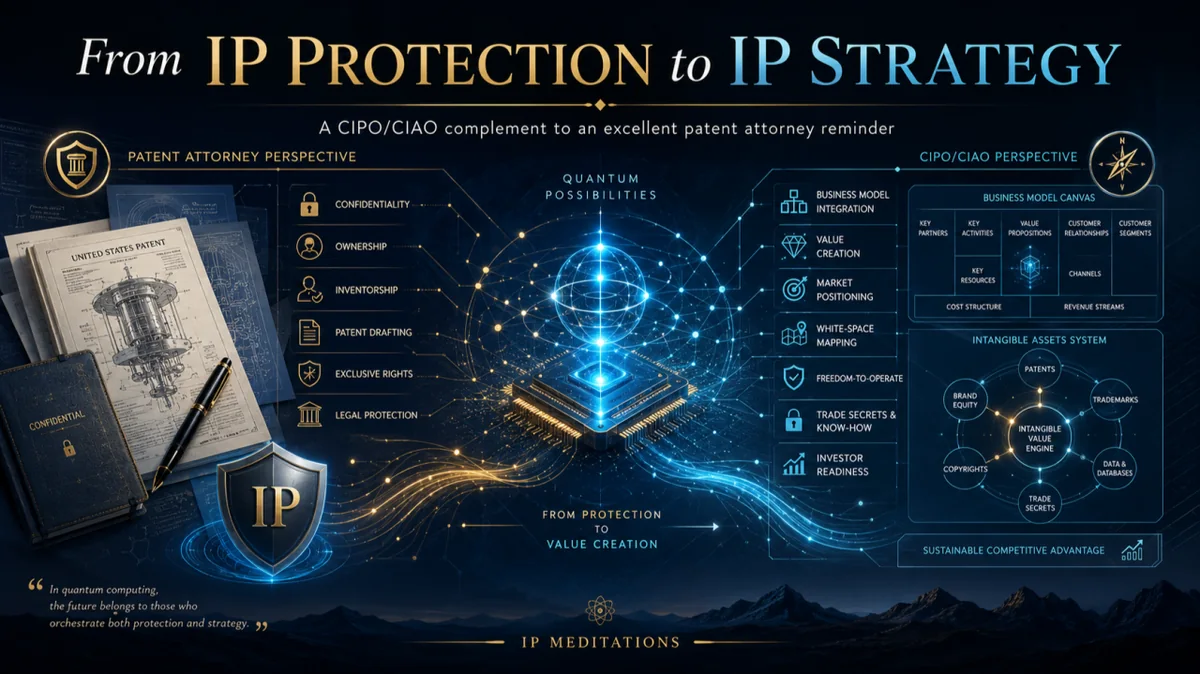
Today, I would like to discuss the main difference of what a patent attorney calls "IP Strategy" and what a Chief IP Officer calls an IP STRATEGY!
From a patent attorney's perspective, the message is clear: in quantum computing, IP must be considered from day one. Confidentiality managed from the start. Collaboration agreements defined before the work begins. Ownership and inventorship secured. The right tools — patents, trade secrets, copyright, trademarks — chosen in alignment with the company's stage of development.
I fully agree. This is essential.
Too many deeptech and quantum startups still treat IP as a legal formality — something to handle once the technology is "ready." But in quantum computing. and in deeptech in general, by the time the technology looks ready, the strategic window may already have closed.
- A disclosure may already have destroyed novelty.
- A collaboration may already have created ownership ambiguity.
- A publication may already have revealed the wrong layer of know-how.
- A competitor may already have occupied a key position.
- A core algorithm may already have been shared without adequate contractual control.
- A valuable trade secret may already have become an undocumented habit inside the lab.
So yes — IP matters early. But from the perspective of a Chief Intellectual Property Officer or more broadlly of a Chief Intangible Assets Officer, I would go one step further.
The Deeper Question
The patent attorney asks: "How do we protect quantum innovation early?"
The CIPO/CIAO asks: "How do we convert a business model and a business strategy into an IP architecture capable of creating, capturing and defending value?"
Because this is where IP transcends protection.
- It becomes strategy.
- It becomes positioning.
- It becomes value architecture.
IP Strategy Should Not Start With Patents
One of the most common mistakes in deeptech is opening the IP conversation with:
"What can we patent?"
It is a natural question. An important one. But it is not the first strategic question.
The first question should be: "Where and How does this company create value?"
Then: "Where and How does this company capture value?"
Then: "Where and How can this value be copied, bypassed, absorbed, neutralized — or simply lost through poor governance?"
Only after answering these questions can the right IP strategy be designed.
IP strategy should not be a legal layer placed on top of the business. It should be the strategic translation of the business model itself.
A quantum startup building hardware does not create and capture value the same way as one developing algorithms, middleware, error correction, control software, cryogenic components, photonic architectures, sensing platforms, or quantum cybersecurity. A company selling cloud access does not need the same IP architecture as one licensing a component, deploying a full-stack machine, or partnering with industrial integrators.
- The business model defines the value logic.
- The value logic defines the vulnerability map.
- The vulnerability map defines the IP strategy.
Business Model → Value Creation → IP Strategy
For a CIPO/CIAO, the starting point is never the patent application. It is the business model.
Will the company sell hardware? License technology? Offer quantum-as-a-service? Own a critical enabling layer? Build an ecosystem? Capture recurring revenue through access, performance, data, trust, or switching costs?
Each answer leads to a different IP architecture:
- If the value is in hardware: protect architecture, manufacturing processes, calibration methods, and supply-chain know-how.
- If the value is in software: combine copyright, trade secrets, selective patenting, API control, data governance, and contractual restrictions.
- If the value is in algorithms: the choice between patent and secrecy becomes strategically critical — and must be made deliberately.
- If the value is in integration: the key assets may not be the core quantum technology itself, but the interfaces, workflows, data, engineering processes, and deployment methods that make it commercially usable.
This is why a real IP strategy is not a list of filings. It is a map of value.
IP as a Market Positioning Tool
IP is often presented as a defensive instrument: protect the invention, prevent copying, reduce risk.
All of that is true.
But in deeptech, IP can also serve as a strategic compass.
A rigorous IP landscape reveals where the market is crowded, where competitors are investing, where white spaces exist, where patent thickets are forming, and where a startup might build a differentiated, defensible position — before the competition even sees it.
This is not legal intelligence alone. It is market intelligence.
A quantum startup may discover that its initial positioning is too close to a heavily patented zone. It may realize that an enabling interface is more defensible than the core invention. It may identify an overlooked layer of the stack where value can be captured more effectively.
This is where IP asks the questions that matter most:
- Where should we innovate?
- Where should we avoid unnecessary battles?
- Where can we build defensible differentiation?
- Where can we become unavoidable in the value chain?
In quantum computing, market positioning is still fluid. Business models are still evolving. Standards, platforms, partnerships and ecosystems are still being built.
That means IP is not only about protecting what already exists. It is about deciding where to go next.
From Patent Portfolio to IP Operating System
IP strategy must evolve with the company's stage — early focus on collaboration clarity and investment readiness, later focus on market share and enforcement.
This is exactly why quantum companies need more than isolated IP advice.
They need an IP operating system.
One that connects business strategy, R&D roadmap, patent strategy, trade secret governance, software protection, data management, collaboration agreements, investor readiness, freedom-to-operate, market positioning, licensing, and value capture — into a single, coherent architecture.
This is the role of the CIPO/CIAO.
The patent attorney is essential for drafting, prosecution, and legal execution.
The CIPO/CIAO asks a different question: "How do all intangible assets work together to create strategic advantage?"
In quantum, the value of a company rarely sits in one patent.
It sits in a system — a controlled architecture of knowledge, people, data, know-how, code, experiments, methods, contracts, reputation, publications, trade secrets and strategic narratives.
The patent is one instrument. The portfolio is one layer. The real asset is the architecture.
Trade Secrets Are Not a Default — They Are a Discipline
Use trade secrets for inventions that are difficult to detect or where patent disclosure would be commercially unwise.
Crucial point.
But the CIPO/CIAO question is not only "Should we use trade secrets?" Is is mainly "Can we prove that we have managed them as trade secrets?"
A trade secret is not merely something unpublished. It is something identified, documented, access-controlled, monitored, and strategically governed.
In quantum, this matters acutely. Much of the value may live in non-obvious layers: experimental parameters, calibration routines, manufacturing tolerances, control software, error mitigation methods, lab workflows, benchmarking methods, supplier knowledge — and the tacit knowledge accumulated inside the team.
- If these assets are not mapped and governed, they may exist scientifically.
- But not strategically.
- They may be valuable, but not investable.
- They may be known internally, but not defensible externally.
Every serious quantum startup needs a trade secret protocol.
Not a generic NDA folder.
A living system.
Freedom-to-Operate Is Not a Late Legal Check
FTO is too often treated as a final-stage analysis performed when the product is almost ready for market.
In deeptech, this is risky. In quantum, it is dangerous. Freedom-to-operate should not be a final exam. It should be an early navigation instrument.
A well-conducted FTO landscape helps the company understand which technological routes may be blocked, which are safer, where design-arounds are possible, where licensing may be needed, and where new filings could create strategic leverage.
This transforms FTO from a risk report into a strategic design tool.
The best IP strategy is not the one that protects innovation after it happens. It is the one that steers innovation toward defensible, valuable, commercially relevant spaces.
Investor Readiness Starts Before the Data Room
Early IP decisions can have lasting consequences during due diligence.
This deserves to be amplified.
Investor readiness does not begin when the investor asks for the IP folder.
It begins the day the company starts creating knowledge.
Every invention disclosure, collaboration agreement, lab notebook, software contribution, founder assignment, contractor agreement, publication decision, data flow, open-source dependency, trade secret record — all of it contributes to the future due diligence story.
And investors do not only ask: "Do you have patents?"
They ask — directly or indirectly:
- Do you own what you claim to own?
- Can you defend your position?
- Can you commercialize without infringing others?
- Is your know-how controlled?
- Are your collaborations clean?
- Is your software ownership clear?
- Are your trade secrets documented?
- Does the portfolio support the valuation story?
A startup that can answer these questions clearly has more than an IP portfolio.
It has credibility.
And in fundraising, credibility is capital.
The CIPO/CIAO Complement
So yes — the patent attorney's message stands:
- Think about IP early.
- Protect confidentiality.
- Secure ownership.
- Choose the right protection tools.
- Structure collaborations carefully.
- Adapt the strategy as the company grows.
The CIPO/CIAO complement is this:
- Convert the business model into an IP strategy.
- Convert the IP strategy into a value creation system.
- Convert the value creation system into market positioning.
- Convert market positioning into investor confidence.
- Convert intangible assets into strategic leverage.
This is the missing bridge.
- Between science and business.
- Between invention and valuation.
- Between protection and growth.
- Between patents and power.
The Meditation
A quantum company does not only compete with qubits, algorithms or architectures.
It competes with its ability to transform knowledge into controlled strategic advantage.
- An idea is not yet an asset.
- An invention is not yet a position.
- A patent is not yet a strategy.
- A secret is not yet protected.
- A collaboration is not yet leverage.
- A technology is not yet a market.
The work of IP strategy is to build the bridge.
- From knowledge to ownership.
- From ownership to freedom.
- From freedom to positioning.
- From positioning to value.
- From value to legacy.
That is why IP must start early.
But more importantly — that is why IP must start strategically.
Because in quantum computing, the future will not belong only to those who invent first.
It will belong to those who understand where value is created, how it is captured, and how it must be protected before the market even realizes what is at stake.
That is the true role of a CIPO/CIAO.
Not merely to protect inventions.
But to design the invisible architecture through which innovation becomes power.