Dear Readers, Strategists and Game-Changers,
Hope you are doing great!
This week I had the honour to be invited to the World Economic Forum #WEF in Davos to provide my insights in a closed-door discussion about Quantum, AI and Investment with my precious view of these industries through the lens of Intangible Assets. What a great discussion and brilliant minds!
During this discussion, the topic of Quantum platforms as investment opportunities and key solutions to get market shares as been discussed.
Today, I would like to share my thoughts on this topic with you!
More and more quantum companies are no longer “selling a machine” (or even “selling compute”). They are building platforms: environments where developers, enterprises, and partners come to build, test, integrate, and deploy - and where the platform owner captures value through usage, subscriptions, marketplaces, and ecosystem lock-in.
That shift changes everything!
In hardware races, advantage is often measured in qubits, fidelity, and error rates. In platform races, advantage is measured in intangible assets: IP, software, data, standards influence, brand trust, developer mindshare, partner gravity, and contractual positioning.
And in quantum computing - where timelines are uncertain and technical differentiation can be temporary - intangibles are the most durable compounding assets you can build.
The quantum platform stack: where value is actually captured
A quantum platform is not one thing. It’s a stack:
Layer A — Access (Distribution)
Cloud access to quantum devices and simulators (the “on-ramp” for users). Examples: Amazon Braket, Microsoft Azure Quantum, IBM Quantum Platform.
Layer B — Runtime & orchestration (Control)
Hybrid workflows (classical + quantum), scheduling, resource estimation, priority access, workload management.
Layer C — SDKs & tooling (Adoption)
The developer experience: SDKs, libraries, notebooks, debugging, transpilers/compilers, benchmarking. Example: Qiskit as an open-source SDK tied to IBM’s platform strategy.
Layer D — Integration (Enterprise gravity)
Security, compliance, auditability, SLAs, procurement readiness, identity management, integration into existing cloud and HPC ecosystems.
Layer E — Applications & ecosystem (Monetization)
Pre-built algorithms, vertical solutions, partner marketplace, certification programs, “app store” dynamics.
Strategic point: in quantum, the platform owner who becomes the default workflow layer wins disproportionate mindshare - even if the underlying hardware leadership shifts over time.
The intangible asset stack: your real platform moat
When you say “IP strategy for a quantum platform,” most people hear “patents.”
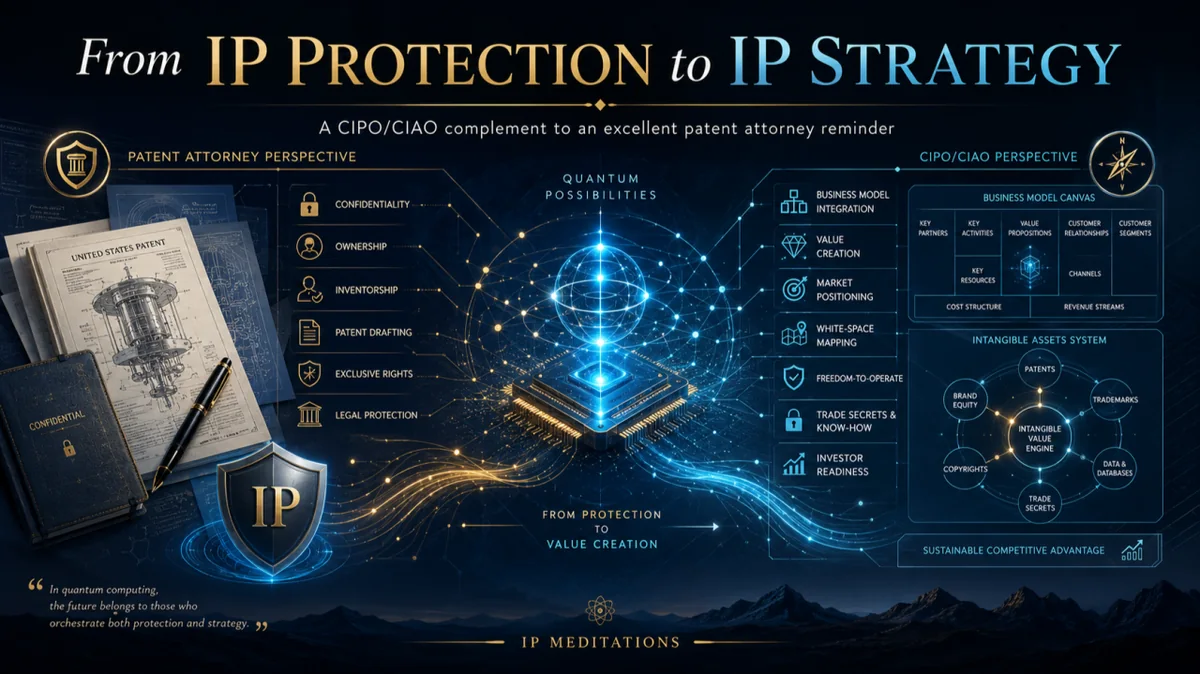
But platform advantage is rarely defended by patents alone. It is defended by a portfolio of intangible assets that reinforce each other:
(1) IP rights: defend the differentiators and the interfaces
Patents (selectively): where they block competitors or strengthen negotiating power (cross-licensing, partnerships, procurement).
Trade secrets: calibration methods, error mitigation heuristics, compiler optimizations, performance tuning, roadmaps, etc...
Copyright: SDK source code (where not open), documentation, UI flows, training content.
Trademarks: platform name, product family naming, certification marks (critical for trust).
Contracts: the underrated IP layer - license terms, usage rights, marketplace rules, contribution policies.
Platform-specific nuance: In platforms, the strategic target is often not “the algorithm” - it’s the interface (APIs, SDK conventions, workflow primitives). If your interface becomes the default, competitors must either integrate (on your terms) or fight uphill to shift developer habits.
(2) Data assets: quantum’s hidden gold
Quantum platforms generate valuable data that compounds:
device performance telemetry,
calibration histories,
error models,
benchmark suites and reproducibility traces,
usage patterns that inform product direction.
Handled well, this becomes a learning flywheel: better data → better tooling → better performance for users → more users → more data.
Handled poorly, it becomes a liability (IP leakage, security risk, governance failure). So data strategy must include rights, controls, and a “what we share vs keep” policy.
(3) Human and organizational capital: the platform’s “un-copyable” engine
In quantum, the scarce resource is not only capital - it’s teams that can convert physics into product.
Your platform’s compounding advantage often comes from:
internal technical playbooks,
architectural discipline,
documentation culture,
developer advocacy excellence,
a roadmap process that consistently ships.
(4) Relational capital: partnerships as distribution + legitimacy
Quantum platforms are ecosystems by necessity: hardware partners, cloud partners, research labs, enterprise integrators.
Distribution and trust often arrive through these relationships - then become defensible via:
exclusivities (carefully),
certification programs,
co-marketing structures,
joint solution IP,
procurement frameworks.
3) Openness is not a philosophy. It’s a business model decision.
Quantum has a strong open-science culture, and software communities often expect open tooling.
So the real strategic question becomes:
What do you open to accelerate adoption, and what do you keep proprietary to capture value?
Common winning patterns:
Open-core platform strategy
Open: SDK, basic tooling, education layer, community contributions.
Proprietary: runtime features, orchestration, performance optimizations, enterprise controls, premium libraries, marketplace economics.
This is exactly why open-source SDKs and languages matter strategically. For instance, Microsoft positions Q# as a high-level open-source quantum language within its broader quantum development ecosystem.
And it’s why developer frameworks like PennyLane (open-source) can be a major adoption lever - especially where the workflow bridges classical ML and quantum.
My rule of thumb: Open what spreads. Protect what pays.
4) The Platform IP Blueprint for quantum companies
If you’re building a quantum platform, design your intangible strategy like a system:
Step 1 — Map your value capture points
Where do you monetize?
usage (compute minutes / shots),
subscriptions (tooling tiers),
enterprise packages (security, SLAs),
marketplace take-rate,
services (integration, consulting),
licensing (software, workflows, IP).
Step 2 — Identify your “non-negotiables”
What must remain yours?
orchestration layer,
performance tuning,
reproducibility pipeline,
enterprise governance layer,
marketplace governance and economics.
Step 3 — Protect interfaces, not just inventions
Create an “interface moat”:
consistent APIs,
stable primitives,
strong docs + education,
certification and partner standards,
careful licensing terms.
Step 4 — Treat contracts as core intangible assets
Platform contracts define:
who owns what output,
whether user code can be reused,
contribution rules (inbound licensing),
audit rights,
indemnities,
partner constraints and exclusivities.
This is where many quantum platforms quietly win or lose.
Step 5 — Operationalize trade secrets (don’t “hope” they stay secret)
A trade secret is not a feeling. It’s a system:
access controls,
documentation discipline,
clean-room protocols when needed,
partner boundary rules,
employee onboarding/offboarding.
Step 6 — Build trust as a moat
In quantum platforms, trust is monetizable:
security posture,
reproducibility,
transparent benchmarking,
procurement readiness,
governance.
5) Real-world platform signals: what the market is rewarding
We can see the platform direction in how leading players present themselves:
Amazon Braket emphasizes a consistent development experience across multiple quantum hardware types and managed workflows.
IBM Quantum Platform + Qiskit positions the platform as the place to access hardware, tools, and learning - using an open-source SDK as a major adoption engine.
IonQ highlights cloud access via major cloud platforms and direct API access - distribution as a strategic asset.
Quantinuum frames its “full-stack” platform approach with Nexus as the workflow entry point.
And investors are rewarding “platform-like” narratives and assets (technology + ecosystem + defensible stack). For example, Reuters reported Quantinuum’s 2025 funding round valuing it around $10B, tied to its full-stack positioning and strategic momentum.
Closing thought: in quantum, hardware is the wave. Platforms are the coastline.
Quantum computing will likely remain a shifting landscape for years: breakthroughs, bottlenecks, pivots, new modalities.
But platforms - if built with the right intangible asset strategy - become the persistent layer where value accumulates regardless of which hardware modality leads at a given moment.
So if you are building a quantum platform, ask yourself:
Are we building an ecosystem, or just a product?
Do we know exactly which intangibles compound for us?
Are our openness choices accelerating adoption and protecting value capture?
Do our contracts reflect our strategy - or merely our habits?
Because in platform businesses, the winners are rarely the ones who invent the most.
They are the ones who design the most compounding intangible system.