Dear Readers, Strategists and Game-Changers,
Hope you are doing great!
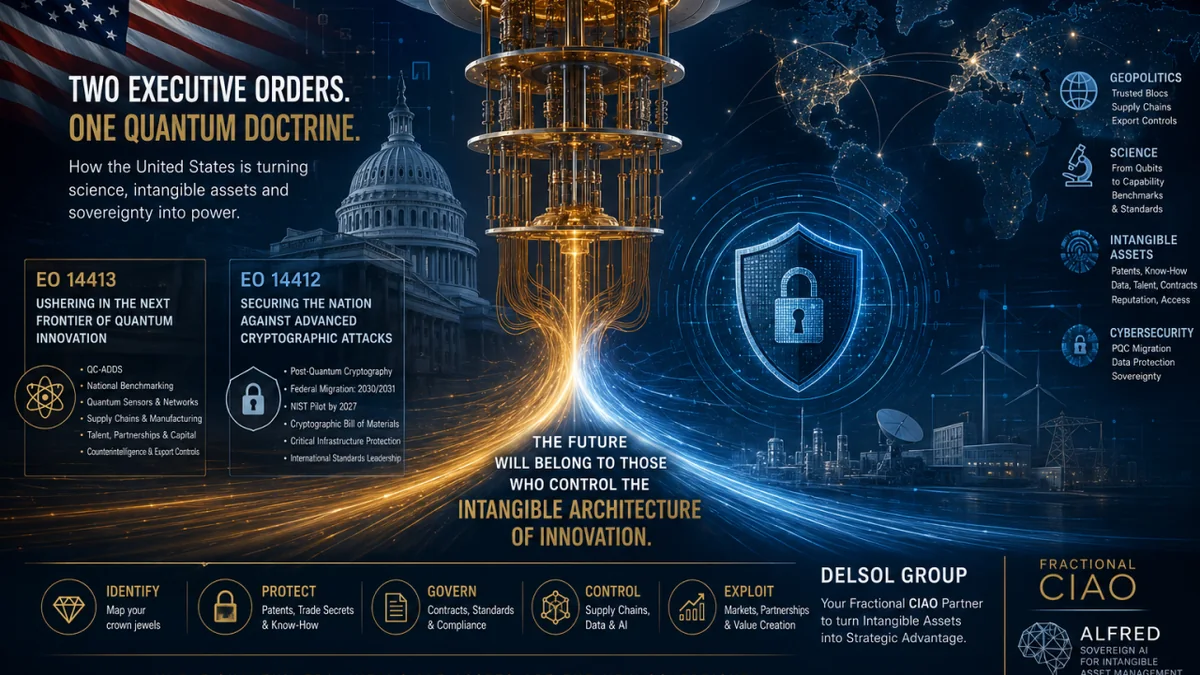
As scheduled, today we continue our IP trip within the World Quantum IP Landscape, and our next destination is the USA from a strategic point of view!
In the 20th century, power was measured in land, oil, and armies. In the 21st, it is measured in patents, platforms, and knowledge networks. As the quantum century begins, the new map of power is drawn not on geography — but on intellectual property.
And in this silent redrawing of borders, one nation stands at the center.
The United States is not only leading the Quantum IP Landscape; it is designing it. It treats invention as strategy, research as policy, and patents as instruments of sovereignty. While others chase speed, the U.S. builds systems. While others count patents, it counts influence.
This is not luck. It is architecture.
I. The Strategic DNA of American Innovation
The American innovation model is not spontaneous; it’s systemic. It operates through a cultural and institutional equation that has defined its technological rise for a century:
Science + Capital + Law = Power.
Each term in that equation is deliberate.
Science as Vision. The United States invests not in technology, but in technological paradigms. The National Quantum Initiative Act (2018, renewed 2022) and the CHIPS & Science Act (2023) created a unified governance and funding ecosystem — a rare coherence between policy and purpose.
Capital as Catalyst. Venture capital in the U.S. doesn’t wait for certainty. It funds readiness. In 2024, North America accounted for ~70% of global quantum financing, leading $2.6 billion in startup investments — a 58% growth from 2023 (ICV Quantum Report, 2025). The underlying message: risk is not an obstacle; it’s the business model.
Law as Leverage. Intellectual property is treated as strategic infrastructure — the legal fabric that sustains national advantage. The U.S. controls ~48% of all international quantum patent families, a dominance confirmed by the European Quantum Industry Consortium (QuIC, 2024). These are not random filings; they are nodes of control in a global architecture of access.
Together, these three pillars ensure that discovery in the U.S. doesn’t end in a publication — it ends in a position.
II. The Triple Helix: A Strategic Operating System
The U.S. innovation engine runs on the Triple Helix Model — the continuous feedback loop between academia, industry, and government.
Academia provides curiosity and credibility — Massachusetts Institute of Technology, Harvard University, Caltech, Stanford University, and national labs form the cognitive core.
Industry provides scale — IBM, Google, Microsoft, Intel Corporation, and Honeywell translate science into products, platforms, and patents.
Government provides coherence — Defense Advanced Research Projects Agency (DARPA), DOE, National Institute of Standards and Technology (NIST), and NSF ensure direction, funding, and strategic oversight.
This model doesn’t just produce breakthroughs; it produces alignment. When a scientific discovery occurs in the U.S., it’s already embedded in a framework of investors, legal counsel, and industrial partners ready to operationalize it.
That is why the U.S. innovation cycle moves faster — not because of more resources, but because of frictionless translation from concept to market.
III. Quality as Strategy
In quantum IP, the U.S. leads through depth, not breadth. While China dominates filings by volume (over 50% of global quantum patents), the U.S. leads every quality metric — citations, international families, and commercialization rate.
According to DLA Piper’s 2025 Quantum IP Trends Report, American patents are cited 2.7× more often than Chinese ones, reflecting influence over imitation.
Each U.S. patent family becomes a strategic territory:
A cited patent defines a standard.
A licensed patent defines a dependency.
A global patent family defines a sphere of influence.
In this sense, IP is not protection; it is projection. It’s how a nation expands its invisible borders — through enforceable ideas rather than physical land.
IV. The Corporate Vanguard — Companies as States
In the quantum race, corporations act as technological nation-states. IBM, Google, Microsoft, Intel, and Amazon are no longer private players — they are strategic actors with global influence.
IBM Quantum Network connects 500+ partners across 40 countries — a geopolitical alliance of innovation, not politics.
Google redefined performance metrics with its quantum supremacy experiment and now embeds its IP within cloud platforms — turning dependence into ecosystem control.
Microsoft bets on topological qubits and hybrid cloud integration, protecting not just technology, but infrastructure-level standards.
Honeywell/Quantinuum focuses on dual-use encryption — a perfect embodiment of technological sovereignty: civilian and defense layers converging under one IP strategy.
These companies operate as both innovators and regulators of access. They create what we might call corporate sovereignties — semi-autonomous ecosystems governed by IP portfolios rather than borders.
V. Capital as Strategic Energy
The U.S. venture capital ecosystem transforms uncertainty into momentum. Funds such as Andreessen Horowitz, DCVC, Lux Capital, and Playground Global back quantum ventures precisely because they sit at the intersection of deep science and scalable opportunity.
These investors don’t buy revenue; they buy narratives of inevitability. They fund startups like Rigetti Computing, Q-CTRL, PsiQuantum, and IonQ not for immediate return, but to colonize the frontier — securing early IP positions in architectures that will define the next industrial wave.
Unlike Europe, where funding often stops at proof of concept, or Asia, where it is directed by state priority, U.S. capital acts as a living organism — self-reinforcing, fast, and opportunistic.
VI. IP as Sovereignty
In the American model, IP is the soft power of the quantum age. It ensures that when global standards for quantum communication, encryption, or cloud protocols are finalized, the U.S. will own the keys — not just the hardware.
This is not protectionism; it’s preemptive diplomacy. Licensing structures, export controls, and collaborative frameworks with allies (Japan, Canada, EU, Australia) transform IP into geopolitical alignment tools.
In the same way energy independence defined the 20th century, IP independence defines the 21st. It allows nations — and corporations — to act without permission.
VII. Strategic Insights: The U.S. Playbook
The U.S. quantum IP strategy reveals a playbook every serious innovation economy should study:
Design Ecosystems, Not Projects. The U.S. doesn’t launch isolated programs — it builds feedback systems that evolve autonomously.
Institutionalize Risk. Venture funding and public R&D policy treat uncertainty as an asset, not a liability.
Anticipate Markets Through IP. Patents are filed not when the market exists, but to make the market exist later.
Globalize Ownership. With nearly half of international quantum patents, the U.S. ensures its inventions shape other nations’ technological landscape.
Fuse Capital, Science, and Law. The real power of innovation lies in combining technical discovery, financial scalability, and legal protection into a single, self-reinforcing loop.
VIII. From Control to Governance
But leadership demands restraint. Quantum computing, encryption, and sensing will redefine finance, defense, and intelligence. With that power comes an ethical obligation: to govern without domination.
The U.S. faces a test of philosophical maturity: Can it continue to lead without converting its IP dominance into technological dependence for others? Can it balance sovereignty with collaboration?
The future of global innovation will depend not only on who leads — but on how they lead.
IX. The Enduring Advantage
America’s true competitive edge lies not in speed or scale, but consistency. Its innovation infrastructure — legal, financial, and cultural — is self-repairing. It survives crises, changes of administration, and market corrections.
This structural inertia ensures that once the U.S. takes the lead, it rarely loses it.
Quantum may be no exception. By combining early investment, strong IP enforcement, and global partnerships, the U.S. has created an ecosystem that doesn’t just innovate — it regenerates.
X. Conclusion — The Empire of the Intangible
In the quantum age, the U.S. no longer builds empires of territory, but empires of thought. It governs through code, contracts, and patents — the intangible infrastructure of the modern world. It wins not by occupying land, but by occupying the standards others must follow.
Where China scales, and Europe philosophizes, America strategizes. It plays not to compete, but to design the game itself.
And in this silent war of ideas, one truth endures:
Those who master the invisible will rule the visible.