Dear Readers, Strategists and Game-Changers,
Hope you are doing great!
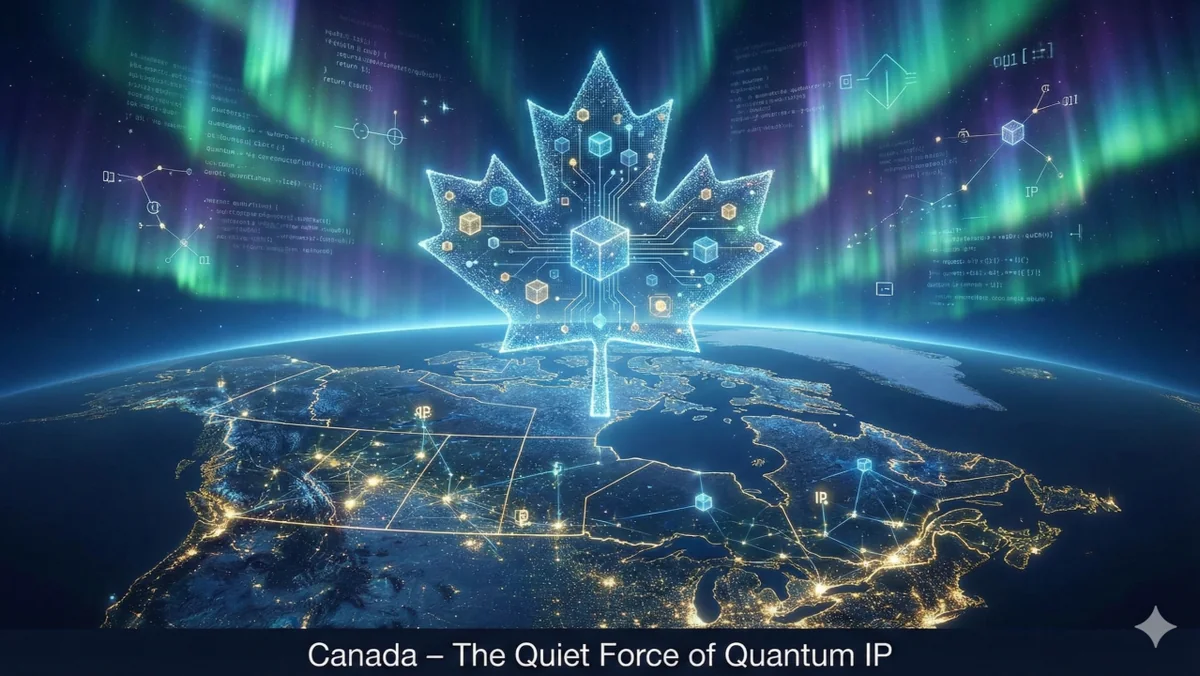
As scheduled, today we continue our IP trip within the World Quantum IP Landscape, and our next destination is Canada!
Where the United States dreams in ecosystems (see my dedicated articles here and here), China dreams in continuity (see my dedicated articles here, here and here), and Europe is a fragmented genius (see my dedicated articles here, here and here), Canada is the silent and quiet force in the quantum field!
Indeed, in a world where quantum power is measured in qubits, budgets, and patent counts, Canada’s strategy looks almost paradoxical.
On the global map, it is not a giant. It does not dominate the charts the way the United States or China does. And yet, when you look at how efficiently it converts knowledge into protected inventions, Canada behaves less like a small player and more like a master craftsman.
This is the essence of the Canadian quantum IP story: not empire building, but precision carving.
In this week’s IP Meditations, we travel to a country that “punches above its weight” in quantum IP – and we ask what its path can teach us about strategy, sovereignty, and the power of focus.
1. A Quiet Outlier in the Quantum Race
When you scan the global quantum patent landscape, four big labels usually appear:
US: value and influence leader,
China: volume leader,
Europe: fragmented mosaic,
Canada: niche strength.
The numbers from global analysis are striking:
Canada holds roughly 2–4% of international quantum patent families – a small share in absolute terms.
Yet it does so with a tiny ecosystem of roughly 10–15 core quantum companies.
That translates into an efficiency of about 8–10 patents per company – one of the highest ratios in advanced economies, far above Europe’s ~0.69 patents per company.
In other words:
Canada is not a quantum superpower by volume, but it is an efficiency outlier.
From an IP strategist’s lens, this already tells us something important: Canada is not trying to be everywhere. It is trying to be very good where it chooses to play.
2. D-Wave and the Birth of a Quantum Archetype
To understand Canada’s quantum IP psyche, you must begin with D-WAVE SYSTEM LIMITED.
Founded in 1999 in Burnaby, British Columbia,
First company to commercialize a quantum computer,
Pioneer of quantum annealing and adiabatic quantum computing,
Deployed multiple hardware generations: D-Wave One, Two, 2X, 2000Q, and Advantage, often accessed via the cloud.
In the 2000s, D-Wave was so active in quantum computing patents that it temporarily reshaped the landscape:
It ranked as the world’s number one quantum computing patent holder in the 2000–2009 period, with about 36 patents in that decade alone.
Across the broader time frame, it accumulated more than 100 patent families, focused on architectures, embedding methods, annealing processes, and control schemes.
From a meditative IP perspective, D-Wave is not just a company. It is an archetype:
It embodies focused specialization (annealing instead of trying to dominate every quantum paradigm).
It demonstrates how one firm can temporarily become a global center of gravity in a specific technical niche.
It shows that patent counts alone are less important than where in the architecture those patents sit.
This is Canada’s first quantum lesson:
You don’t need to own the whole chessboard if you control the positions that shape every game.
3. The Canadian Model: Quality over Quantity
Canada is a country that “punches above its weight” in quantum IP – and the data supports this view.
3.1 High patents-per-company efficiency
With only 10–15 significant quantum companies, Canada still contributes 2–4% of all international quantum patents.
That leads to an 8–10 patents per company efficiency ratio – not the brute force growth of China, nor the sprawling ecosystem of the US, but a concentrated beam of IP.
3.2 Niche specialization
Canada’s strengths concentrate around:
Quantum annealing and optimization (D-Wave and related work),
Photonics and optical platforms,
Strong ties to quantum communications and sensing through its research institutions.
This is mirrored in broader global patent analyses, where Canada appears not as the largest actor, but as a noticeable spike associated with a small number of focused assignees.
3.3 Research–industry synergy
Canada’s quantum ecosystem is unusually “tight”:
The Institute for Quantum Computing (IQC) at the University of Waterloo, the Perimeter Institute for Theoretical Physics, and entities like Quantum Valley Ideas Lab and Quantum Valley Investments form a deliberate innovation corridor.
Over the past two decades, this grouping has attracted over CA$1.5 billion in public and private investment, turning Waterloo into the famous “Quantum Valley.”
Instead of scattering efforts, Canada stacked talent, money, and infrastructure in a few key places.
The result is a model that feels almost Japanese in spirit: patient, concentrated, and quality-obsessed.
4. The National Quantum Strategy: A Philosophy in Policy Form
In 2023, Canada made this philosophy explicit with its National Quantum Strategy (NQS).
The numbers:
CA$360 million over seven years (starting from Budget 2021),
Structured around three pillars:
The strategy is built around three missions:
Quantum computing – develop and deploy hardware, software and algorithms.
Quantum communications – secure networks, key distribution and infrastructure.
Quantum sensing – exploit quantum effects for high-precision measurements in health, environment, and security.
Notice the pattern: Canada doesn’t just say “we’ll invest in quantum.” It chooses missions.
And behind the CA$360M headline, there is a deeper timeline:
Canada invested more than CA$1 billion in quantum technologies between 2009 and 2019,
It ranked among the top 5 nations globally in quantum research expenditure,
And it ranks at or near the top for quality and impact of quantum science publications.
So the NQS isn’t the beginning. It is a formalization of a 20-year bet: that a country can shape the quantum era by playing long, deep, and focused.
5. The Double Reality of Canadian Quantum IP
From an IP Meditation perspective, Canada lives in two realities at once.
5.1 The internal reality: concentrated excellence
Domestically:
Canada hosts several quantum companies, the majority being small, Canadian-controlled private companies (CCPC) closely tied to universities.
Many of these companies sit inside or next to research centers: Waterloo, Toronto, Montreal, Vancouver, Calgary, Sherbrooke, etc.
The research-to-company pipeline is relatively fluid compared to many European contexts: professors spin out companies, students join startups, IP is often co-developed.
Canadian analysis shows that quantum patent activity has accelerated sharply since 2015, as well as the creation of quantum companies, mirroring the global surge as quantum R&D moves from purely academic work to commercial platforms.
5.2 The external reality: small share, heavy foreign presence
But there is another side:
A 2024 Canadian ecosystem report notes that Canadian entities own only about 14% of quantum-technology-related patents filed in Canada – the remaining majority belong to foreign companies.
Globally, Canada holds just a few percent of total quantum patent families, according to international patent landscape studies and your own analysis.
This means:
Canada is a high-quality contributor, but its home patent space is already a global battleground.
Foreign players use Canada both as a market and, implicitly, as a test zone for their own IP.
From a sovereignty perspective, this raises a subtle but important question:
Will Canada be primarily a workshop where global players bring their patents — or a studio where Canadian ideas are framed, protected and exported to the world?
6. The Foreign-Oriented Instinct: Canada as a Global Actor
One encouraging sign is how Canadian inventors behave when they do decide to patent.
WIPO’s World IP Indicators 2024 shows that Canada is among the top 10 origins for foreign-oriented patent families, with a relatively high share of patents filed directly abroad (US, Europe, etc.), rather than solely at home.
In simple terms:
When Canadians file patents, they often file with international markets in mind.
They understand that in quantum, value is not just in holding rights in Ottawa, but in securing positions in Washington, Munich, Tokyo, Seoul, and other hubs.
This suggests a specific Canadian IP temperament:
Don’t file everything.
But what you file, deploy it globally.
This is very different from China’s current strategy of huge volumes, mostly domestic, or from Europe’s challenge of under-patenting despite strong science.
It is a Stoic IP posture: accept your scale, invest in what you can control, and make each move count.
7. The Risks of Being a Niche Power
But niche strength is not automatically permanent. For Canada, three risks stand out.
7.1 Being out-scaled
Even with a high efficiency ratio, a small base of companies means:
A handful of acquisitions, failures, or relocations to the US could erase a large fraction of Canada’s quantum IP base.
Global giants (US, Chinese, European, Korean, Japanese) can out-invest and out-file in any niche if they choose to pivot aggressively.
The question is not whether Canada can be efficient. It is whether it can defend and compound this efficiency over 10–20 years.
7.2 Brain and IP drain
Canadian science is world-class. The Council of Canadian Academies notes that Canada ranks very highly in the impact of its quantum research outputs, despite a smaller overall budget.
But:
Talented graduates are heavily courted by US and European firms.
Some of the most promising IP can migrate via founder relocation, acquisitions, or US-domiciled subsidiaries.
If quantum IP arising from Canadian soil is ultimately captured and controlled elsewhere, Canada risks becoming:
The birthplace of quantum ideas, but not the home of quantum power.
7.3 Under-leveraged National Strategy
The National Quantum Strategy’s CA$360M budget is significant, but it sits inside a global arms race where:
The EU, US, China, and others are committing multi-billion programs in quantum and related deeptech,
Private venture capital in the US alone has injected several billions into quantum startups over the past decade.
If the NQS is treated mostly as R&D and ecosystem funding, without a sharp IP and commercialization architecture, Canada may again excel in science but underperform in capture.
8. What Canada Teaches Us About IP Philosophy
Stepping back, what does the Canadian case reveal about IP as a philosophy of strategy, not just a legal toolkit?
8.1 Depth can compensate for size – if you choose well
Canada shows that a country can:
Become a reference point in a specific architecture (quantum annealing),
Build an internationally recognized cluster (Quantum Valley),
Maintain high patents-per-company efficiency and strong research quality.
The meditative lesson:
Scale is not destiny. Clarity of focus can bend the curve.
8.2 Ecosystem design matters more than isolated excellence
Canada’s success is not just D-Wave or one star university.
It is an ecosystem deliberately composed of:
visionary donors and investors (e.g., Quantum Valley Investments),
top-tier research institutes (IQC, Perimeter, Sherbrooke),
tight integration between academia, founders, and capital,
and now, a national strategy that acknowledges these strengths and tries to amplify them.
In IP Meditations terms: The Canadian lesson is that IP excellence emerges from designed relationships, not heroic individuals.
8.3 Sovereignty can be selective
Canada likely cannot – and should not try to – dominate every facet of quantum technology.
But it can decide:
In which domains it wants non-negotiable sovereignty (e.g., certain sensing platforms, cryptographic primitives, or annealing-based optimization infrastructure relevant to its industries),
Where it is comfortable being a partner, and
Where it is willing to be a client.
A small, open economy cannot close itself off. But it can define where it refuses to be dispensable.
9. A Meditation for Canadian Leaders (and Every “Small” Player)
Whether you are reading this from Toronto, Montreal, Zurich, Singapore, Helsinki, or Vancouver, Canada’s quantum IP story poses a set of questions that go beyond geography:
What is your niche of uncompromising excellence? Not a buzzword, but a domain where you are ready to invest for 10–20 years.
Where should your patents sit in the architecture? Are you filing around the edges, or at the interfaces and control points that every ecosystem will touch?
Do you treat IP as a by-product of research, or as an instrument of sovereignty? Canada’s best examples come from treating IP as a way to shape markets, not just to decorate technical work.
Are you designing your ecosystem as carefully as your technology? Funding programs, labs, companies, and investors can be wired together in ways that either dilute or amplify IP.
If you are “small”, are you thinking like a victim – or like a craftsman? Canada’s quantum story is not about having less. It is about doing more with what you choose to own.
10. Closing – The Maple Leaf in the Quantum Sky
In the global night sky of quantum IP, the United States shines like a blazing constellation, China covers large swaths of space with its sheer volume of stars, Europe flickers in clusters of brilliance separated by dark gaps.
Canada is different.
It is a smaller constellation, yes – but its stars are close-packed, and they sit at interesting coordinates.
If Canada continues to pair:
mission-driven public strategy,
ecosystem-level design,
disciplined, internationally oriented IP,
and the humility of a craftsman with the ambition of a sovereign,
then its role in the quantum century will not be to stand in the shadow of empires.
It will be to show them that, sometimes, the most decisive moves come from the quietest player at the table.
And that is perhaps the deepest insight of this Canadian chapter of IP Meditations:
In a world racing to own the code of reality, power is not only in how much you file, but in how intentionally you choose what to own.